Nature & Science
On IntelligenceOn Intelligence

On Intelligence

user-icon

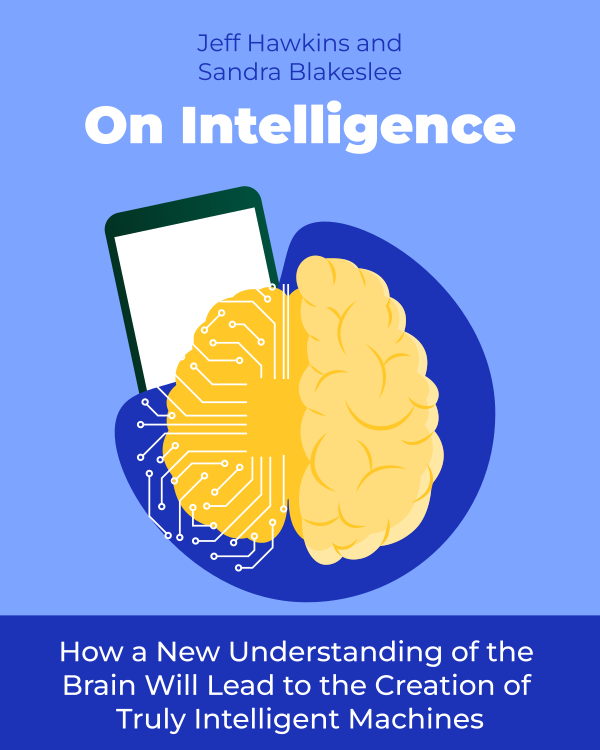
Jeff Hawkins and Sandra Blakeslee

The main idea of this book is that computers are not as smart as humans because they cannot think, learn or use past knowledge to predict the future. To do so, they would have to be built like a neural network, similar to the human neocortex. Fortunately, the technological barriers to achieving this are being overcome. What was discussed in this book? Why have we been unable to create intelligent machines so far? The human brain is an incredibly complex network of neurons that traditional computers cannot replicate. These computers cannot understand the world or learn new things. How can our brains predict future events based on past experiences? When your brain receives sensory information, memories are activated in various regions of the brain in a specific order. When you encounter similar sensory information again, your brain recognizes the pattern and remembers which areas were activated previously. This allows it to anticipate what will happen next. Is it possible and desirable to create intelligent machines? The technological obstacles to building neural networks that mimic the human neocortex may soon be overcome. Such a development would not pose a threat to humanity but instead bring numerous benefits. Guidance for action: Imagine a scenario in which every computer in your home is several times more intelligent than you. How would you utilize their capabilities? What tasks would you assign them? How would you spend your time? The brain is a unique organ, so be careful not to harm it. It has taken millions of years of evolution for the brain to become as intricate and advanced as it is today. Therefore, you should never engage in activities that may damage it, such as substance abuse. Preserving the optimal functioning of your brilliant brain should be a priority.

clock10 min
bite6 Bite
target Wgląd

O czym to jest?

Give a summary of the ability of the human brain to think and to contrast new experiences with past memories. They also clarify why current machines are still unable to recreate this competence, but why we might soon be capable of constructing ones that can.

Streszczenie książki

Jeff Hawkins is the co-founder of the companies Palm and Handspring. After inventing the PalmPilot and the Treo smartphone, he began working for the Redwood Neuroscience Institute, a non-profit organization. It was there that he developed some of the theories presented in these blinks.

The main idea of this book is that computers are not as smart as humans because they cannot think, learn or use past knowledge to predict the future. To do so, they would have to be built like a neural network, similar to the human neocortex. Fortunately, the technological barriers to achieving this are being overcome. What was discussed in this book? Why have we been unable to create intelligent machines so far? The human brain is an incredibly complex network of neurons that traditional computers cannot replicate. These computers cannot understand the world or learn new things. How can our brains predict future events based on past experiences? When your brain receives sensory information, memories are activated in various regions of the brain in a specific order. When you encounter similar sensory information again, your brain recognizes the pattern and remembers which areas were activated previously. This allows it to anticipate what will happen next. Is it possible and desirable to create intelligent machines? The technological obstacles to building neural networks that mimic the human neocortex may soon be overcome. Such a development would not pose a threat to humanity but instead bring numerous benefits. Guidance for action: Imagine a scenario in which every computer in your home is several times more intelligent than you. How would you utilize their capabilities? What tasks would you assign them? How would you spend your time? The brain is a unique organ, so be careful not to harm it. It has taken millions of years of evolution for the brain to become as intricate and advanced as it is today. Therefore, you should never engage in activities that may damage it, such as substance abuse. Preserving the optimal functioning of your brilliant brain should be a priority.

Aby przeczytać resztę książki, możesz pobrać Bitely

appstoregoogleplayapp gallery
Wszystkie kęsy
bite6 Bites

Increasing the capabilities of computers will not lead to an enhancement of their cognitive abilities.

1
logo

Our brain stores and processes sensory information, encoding it into various memory layers.

2
logo

Our mind utilizes recollections of its previous responses to forecast approaching circumstances. Our mental capacity relies on past reactions to anticipate forthcoming situations. The brain depends on past experiences to foretell future occurrences. The mind utilizes memories from the past to anticipate events that lie ahead. Our brain utilizes past reactions to foresee what awaits in the future.

3
logo

Neural networks cannot replicate the intricacy of the brain due to their lack of complexity. The complexity of the brain is not present in neural networks, thus preventing the replication of its functionality. Imitating the brain is beyond the capabilities of neural networks as they do not possess the same level of complexity. Neural networks are incapable of imitating the brain due to their inadequacy in complexity. The brain's complexity cannot be imitated by neural networks as they fall short in this aspect.

4
logo

In the near future, it is likely that scientists will have the capability to construct machines with artificial intelligence. In the imminent future, it is probable that scientists will possess the capacity to fabricate machines with cognitive abilities. In the close future, there is a high possibility that scientists will develop the competence to assemble machines with intellect. In the foreseeable future, it seems plausible that scientists will achieve the capability to generate machines with advanced thinking capacities. In the upcoming future, it is anticipated that scientists will obtain the skill to manufacture machines with cognitive capabilities.

5
logo

Intelligent machines pose no danger to mankind; instead, they will bring forth countless advantages.

6
logo

Powiązane książki

mailbox-icon

Chcesz kontynuować naukę?

Nie przegap aktualizacji z ekscytującego wszechświata Bitely!

Logo
appstoregoogleplay
app gallery

Śledź nas w mediach społecznościowych

tiktokxinstagramyoutubelinkedinfacebook
© 2025 Bitely. Wszelkie prawa zastrzeżone.