Biography & History
AliAli

Ali

user-icon

Jonathan Eig

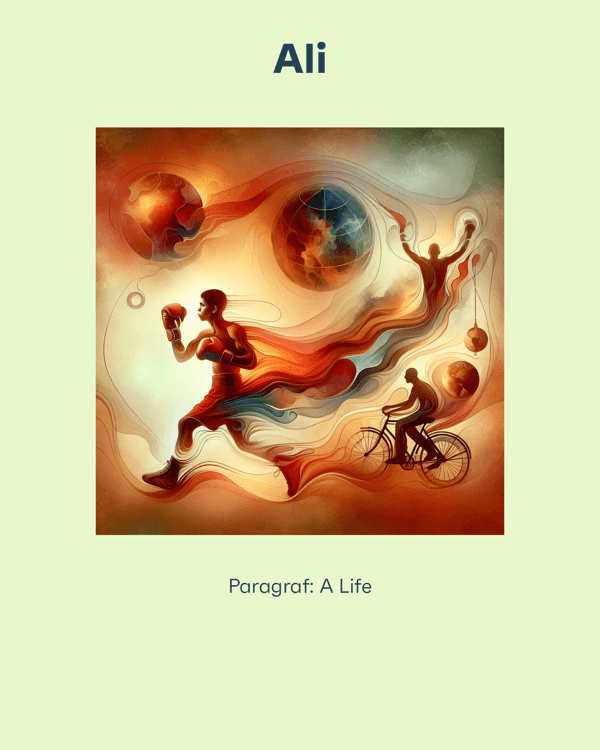
In 1960, 18-year-old Cassius Clay gained international fame by winning a gold medal in boxing at the Rome Olympics, defeating formidable opponents through skill and determination. This victory marked the beginning of his rise to prominence. However, Clay’s journey began years earlier, sparked by the theft of his bicycle at age 12, which led him to a boxing gym where he discovered his passion for the sport. Despite academic struggles, Clay excelled in boxing, driven by his ambition to prove himself. His early life was shaped by a loving but modest upbringing in Louisville, Kentucky, where his family, despite financial hardships, provided him with a nurturing environment. Clay’s lineage reflected a complex history of resilience, tracing back to enslaved ancestors and their struggles post-emancipation. As he ascended in the boxing world, Clay’s personal transformation paralleled societal upheavals. After defeating Sonny Liston in 1964, he embraced Islam and became Muhammad Ali, using his platform to challenge racial inequality and promote black empowerment. His outspoken opposition to the Vietnam War led to the loss of his boxing titles and a suspension, but Ali remained steadfast in his beliefs. Returning to the ring in 1971, he faced Joe Frazier in "The Fight of the Century," displaying remarkable resilience despite losing the match. Ali’s career saw further triumphs, including his legendary victory over George Foreman in the 1974 "Rumble in the Jungle," reclaiming the heavyweight title. Even as his health declined due to Parkinson’s disease, Ali transitioned into a global humanitarian, leveraging his fame for diplomacy and advocacy, leaving an enduring legacy as both a sports icon and a symbol of courage and conviction.

clock14 min
bite10 Bite
target Wgląd

O czym to jest?

In this captivating exploration of Muhammad Ali's life, readers are taken on a journey through the defining moments that shaped the legendary boxer and cultural icon. From his early days as Cassius Clay, a determined young athlete with a fiery spirit, to his rise as an Olympic champion and heavyweight boxing legend, the narrative delves into his unwavering resilience, groundbreaking activism, and personal transformations. Ali’s story intertwines sports, civil rights, and global diplomacy, offering a profound look at a man who transcended the boxing ring to become a symbol of courage, conviction, and humanity.

Streszczenie książki

Jonathan Eig is an author and journalist from New York City who has written several acclaimed and best-selling books. The fascinating subjects of his biographies include the legendary baseball players Lou Gehrig and Jackie Robinson, and the infamous Chicago gangster Al Capone.

In 1960, 18-year-old Cassius Clay gained international fame by winning a gold medal in boxing at the Rome Olympics, defeating formidable opponents through skill and determination. This victory marked the beginning of his rise to prominence. However, Clay’s journey began years earlier, sparked by the theft of his bicycle at age 12, which led him to a boxing gym where he discovered his passion for the sport. Despite academic struggles, Clay excelled in boxing, driven by his ambition to prove himself. His early life was shaped by a loving but modest upbringing in Louisville, Kentucky, where his family, despite financial hardships, provided him with a nurturing environment. Clay’s lineage reflected a complex history of resilience, tracing back to enslaved ancestors and their struggles post-emancipation. As he ascended in the boxing world, Clay’s personal transformation paralleled societal upheavals. After defeating Sonny Liston in 1964, he embraced Islam and became Muhammad Ali, using his platform to challenge racial inequality and promote black empowerment. His outspoken opposition to the Vietnam War led to the loss of his boxing titles and a suspension, but Ali remained steadfast in his beliefs. Returning to the ring in 1971, he faced Joe Frazier in "The Fight of the Century," displaying remarkable resilience despite losing the match. Ali’s career saw further triumphs, including his legendary victory over George Foreman in the 1974 "Rumble in the Jungle," reclaiming the heavyweight title. Even as his health declined due to Parkinson’s disease, Ali transitioned into a global humanitarian, leveraging his fame for diplomacy and advocacy, leaving an enduring legacy as both a sports icon and a symbol of courage and conviction.

Aby przeczytać resztę książki, możesz pobrać Bitely

appstoregoogleplayapp gallery
Wszystkie kęsy
bite10 Bites

From Enslavement to Greatness: Muhammad Ali's Roots

1
logo

From Boisterous Beginnings to Boxing Greatness

2
logo

From Stolen Bike to Boxing Legend

3
logo

Rising to Glory: Cassius Clay's Olympic Triumph

4
logo

From Clay to Ali: A Champion's Transformation

5
logo

Defying the Draft: Muhammad Ali's Bold Stand

6
logo

Muhammad Ali's Defiance: Boxing Over Belief

7
logo

Clash of Titans: Ali vs. Frazier

8
logo

Ali's Unyielding Quest for Boxing Glory

9
logo

Muhammad Ali: Champion, Diplomat, Humanitarian

10
logo

Powiązane książki

mailbox-icon

Chcesz kontynuować naukę?

Nie przegap aktualizacji z ekscytującego wszechświata Bitely!

Logo
appstoregoogleplay
app gallery

Śledź nas w mediach społecznościowych

tiktokxinstagramyoutubelinkedinfacebook
© 2025 Bitely. Wszelkie prawa zastrzeżone.