Politics & Society
Discipline & PunishDiscipline & Punish
Discipline & Punish

Discipline & Punish

user-icon

Michel Foucault

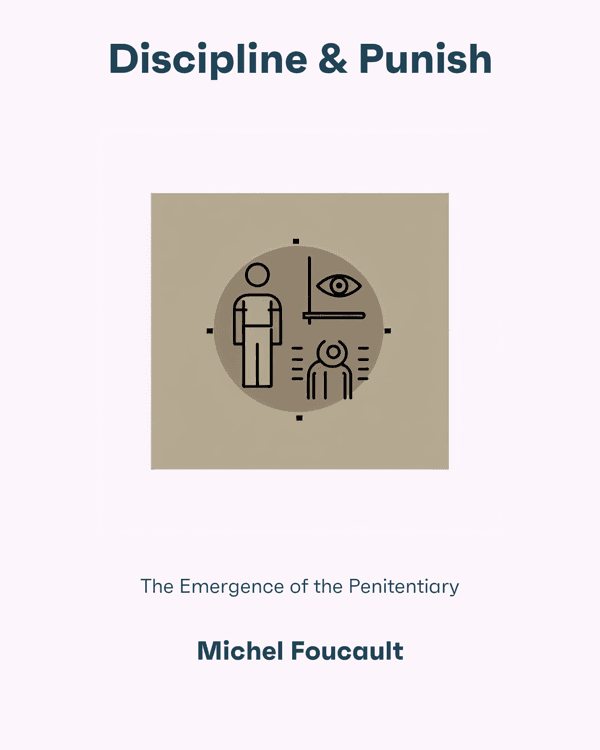
In the late seventeenth century, Europe was being devastated by the plague. Any town that suspected the presence of the disease went into lockdown, with discipline being crucial for safety. Initially, each family was ordered, under the threat of death, to remain within their homes. A syndic, known as an overseer, was appointed to patrol the streets and secure every door he encountered. It was the syndic's responsibility to visit his assigned street daily and call out to the residents of each house. If no one appeared at the window, it indicated a problem; most likely, they were either sick or deceased due to the plague. The syndic then reported his findings to intendants, who in turn informed the magistrates. This hierarchical structure represented the establishment of a sophisticated surveillance system, ironically resulting from the chaos of the epidemic. Additionally, it served as a model for some of the towns' inhabitants, who later became politicians themselves. They aspired to build a flawlessly governed and disciplined society. One common aspect found in such controlled societies is a constant sense of being monitored. This notion can be visualized in the architectural concept of the Panopticon, conceived by English philosopher Jeremy Bentham in 1787. The Panopticon is a circular building resembling a donut, with a central tower. Its windows face towards the inner surface of the donut, while the building is divided into individual cells, extending from the inner to the outer ring. Each cell has two windows, one facing the tower and the other facing outward. This arrangement fosters an atmosphere where the inmates, each confined to their own cell, constantly feel watched. As a result, they behave as if under constant surveillance, regardless of whether someone is actually observing them. It is evident that the Panopticon's design greatly differs from earlier dungeon structures.

hashtagphilosophy
clock11 min
bite6 Bite
target Einblick

Worum geht es?

Discipline & Punish (1975) is a widely acclaimed book written by the renowned French thinker and sociologist Michel Foucault. Foucault delves into the historical progression of power dynamics, methods of punishment, systems of discipline, and surveillance from the era of the French Ancien Régime to our contemporary world. He perceives these phenomena as mirrors of an evolving society.

Buchzusammenfassung

Michel Foucault was one of the most prominent French thinkers of the twentieth century, and his work influenced fields ranging from history to literary criticism. His most notable books include Madness and Civilization and Discipline and Punish.

In the late seventeenth century, Europe was being devastated by the plague. Any town that suspected the presence of the disease went into lockdown, with discipline being crucial for safety. Initially, each family was ordered, under the threat of death, to remain within their homes. A syndic, known as an overseer, was appointed to patrol the streets and secure every door he encountered. It was the syndic's responsibility to visit his assigned street daily and call out to the residents of each house. If no one appeared at the window, it indicated a problem; most likely, they were either sick or deceased due to the plague. The syndic then reported his findings to intendants, who in turn informed the magistrates. This hierarchical structure represented the establishment of a sophisticated surveillance system, ironically resulting from the chaos of the epidemic. Additionally, it served as a model for some of the towns' inhabitants, who later became politicians themselves. They aspired to build a flawlessly governed and disciplined society. One common aspect found in such controlled societies is a constant sense of being monitored. This notion can be visualized in the architectural concept of the Panopticon, conceived by English philosopher Jeremy Bentham in 1787. The Panopticon is a circular building resembling a donut, with a central tower. Its windows face towards the inner surface of the donut, while the building is divided into individual cells, extending from the inner to the outer ring. Each cell has two windows, one facing the tower and the other facing outward. This arrangement fosters an atmosphere where the inmates, each confined to their own cell, constantly feel watched. As a result, they behave as if under constant surveillance, regardless of whether someone is actually observing them. It is evident that the Panopticon's design greatly differs from earlier dungeon structures.

Um den Rest des Buches zu lesen, können Sie Bitely herunterladen

appstoregoogleplayapp gallery
Alle Bissen
bite6 Bites

In the 1800s, the concept of punishing people publicly through physical means transitioned to punishing individuals privately through introspective methods.

1
logo

Both investigation and punishment relied heavily on torture, with public punishment serving as a display of the ruler's authority.

2
logo

The act of criminality started to be seen more and more as a wrongdoing towards society, as investigations attempted to understand the reasoning behind it.

3
logo

The concepts of discipline underwent a major transformation during the 17th and 18th centuries.

4
logo

Disciplinary power was founded upon three principles: hierarchical surveillance, standardizing evaluation, and scrutiny.

5
logo

Bentham's Panopticon revealed that control and authority are imposed through the perpetual sense of being watched.

6
logo

Verwandte Bücher

mailbox-icon

Möchten Sie weiter lernen?

Verpassen Sie keine Updates aus dem aufregenden Universum von Bitely!