Self-Growth
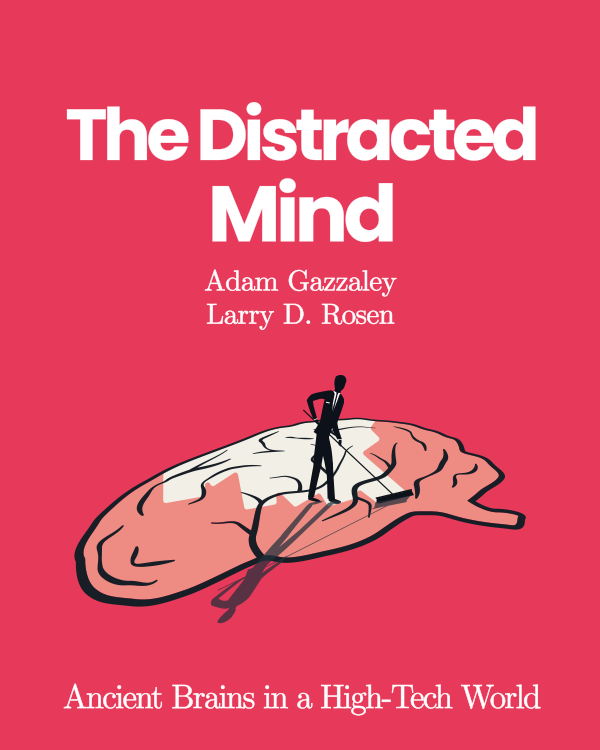
The Distracted MindThe Distracted Mind

The Distracted Mind

user-icon

Adam Gazzaley and Larry D. Rosen

The main idea presented in this text: The human brain can achieve incredible things. However, due to its evolutionary past, it is easily affected by distractions and interruptions. These hindrances prevent us from reaching our objectives efficiently. Fortunately, there are techniques to train your brain and enhance your cognitive abilities. Practical suggestion: Practice mindfulness! Besides physical and mental workouts, mindfulness has been shown to enhance cognitive functions. It might be beneficial to schedule regular mindfulness sessions. Unsure where to start? There are many online resources available, but attending a local class could be a good first step. Want to give your opinion? We are eager to receive your feedback on our content! Drop us a message at [email protected] with the book's title as the subject line and share your thoughts! Recommendation for further reading: You Are Not Your Brain by Jeffrey M. Schwartz and Rebecca Gladding In You Are Not Your Brain, the authors discuss the misleading messages from our brains that lead to negative beliefs like “I'm not capable enough.” They explain how we can challenge and redirect these harmful thoughts, rewiring our brains to work in our favor. Interested in introducing to your team? We offer group subscriptions as well. Get in touch with your Learning & Development department or click the link below to explore how can benefit both you and your team, personally and professionally.

clock15 min
bite8 Bite
target Insight

What's it about?

The book "The Mind that can't Concentrate" (2016) explores the fundamental formations of the mind and queries its ability to operate effectively in a society overwhelmed with advanced devices and continuous diversions. By incorporating recent findings in neuroscience, it provides viable remedies for combatting these distractions and reclaiming concentration.

Book summary

Adam Gazzaley is an American professor and neuroscientist at the University of California, San Francisco. He is also the founder of Neuroscape, a neuroscience center devoted to the understanding and optimization of human brain functions.

The main idea presented in this text: The human brain can achieve incredible things. However, due to its evolutionary past, it is easily affected by distractions and interruptions. These hindrances prevent us from reaching our objectives efficiently. Fortunately, there are techniques to train your brain and enhance your cognitive abilities. Practical suggestion: Practice mindfulness! Besides physical and mental workouts, mindfulness has been shown to enhance cognitive functions. It might be beneficial to schedule regular mindfulness sessions. Unsure where to start? There are many online resources available, but attending a local class could be a good first step. Want to give your opinion? We are eager to receive your feedback on our content! Drop us a message at [email protected] with the book's title as the subject line and share your thoughts! Recommendation for further reading: You Are Not Your Brain by Jeffrey M. Schwartz and Rebecca Gladding In You Are Not Your Brain, the authors discuss the misleading messages from our brains that lead to negative beliefs like “I'm not capable enough.” They explain how we can challenge and redirect these harmful thoughts, rewiring our brains to work in our favor. Interested in introducing to your team? We offer group subscriptions as well. Get in touch with your Learning & Development department or click the link below to explore how can benefit both you and your team, personally and professionally.

To read rest of the book, you can download Bitely

appstoregoogleplayapp gallery
All Bites
bite8 Bites

The constraints of our minds lead us to fall prey to interruptions and diversion.

1
logo

Despite our best efforts, we are inherently wired by evolution to be easily distracted by specific stimuli.

2
logo

The advancement of modern technology can hinder our productivity, yet we tend to allow it as we have a natural inclination towards seeking knowledge.

3
logo

Three inventions have altered social behavior. Three innovations have impacted societal norms. Three advancements have transformed societal customs.

4
logo

Modern advancements in technology have a significant influence on our daily routines and play a role in ensuring our safety – and we willingly embrace this change.

5
logo

Engaging in physical and mental exercises alters your brain and enhances cognitive regulation.

6
logo

There are some tricks that can lessen disruptions during driving.

7
logo

You also have the ability to combat distraction caused by electronics when interacting with others.

8
logo

Related Books

mailbox-icon

Want to keep learning?

Big ideas, bite-sized lessons—feed your curiosity every day with Bitely!