Economy & Finance
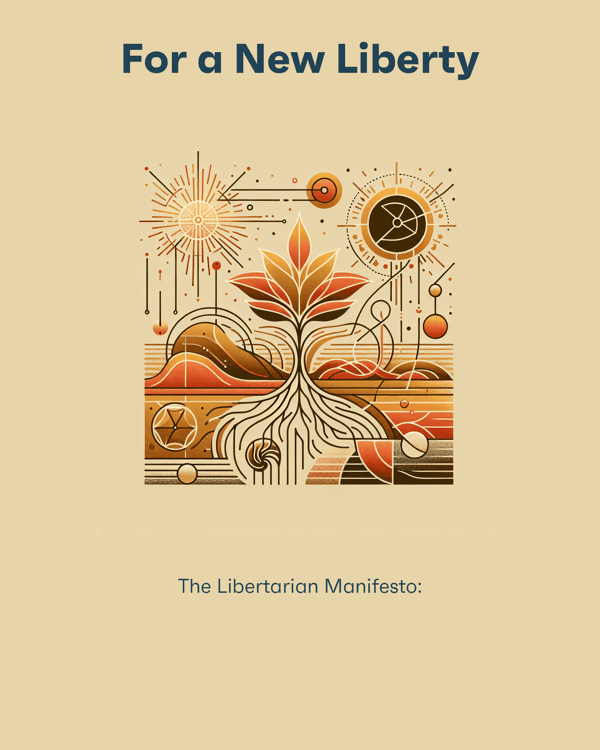
For a New LibertyFor a New Liberty

For a New Liberty

user-icon

Murray N. Rothbard

Libertarianism, once central to America's founding, has been marginalized over time due to expanding government authority, shifts in political movements, and the appropriation of its language by socialism. Despite this, the Libertarian Party remains the third-largest in the U.S., advocating for minimal government interference. Libertarians argue that free markets can address environmental issues better than government intervention, as seen in resource management examples like copper and timber. They also critique public education and welfare systems for stifling individual potential and creating dependency, proposing privatization as a solution. The Federal Reserve is criticized for manipulating the money supply, fueling inflation, and perpetuating economic cycles that benefit the government at the expense of citizens. Libertarians oppose all forms of coercion, including military conscription, excessive taxation, and state-imposed morality, emphasizing the nonaggression principle as their core belief. They advocate for privatizing public services, asserting that the free market can provide better quality and efficiency, while maintaining individual freedoms and property rights.

clock16 min
bite9 Bite
target Insight

What's it about?

Libertarianism explores the philosophy of minimal government intervention, rooted in the nonaggression principle, which opposes initiating violence or coercion. This book delves into the historical evolution of libertarian ideals, their influence on America's founding, and their marginalization in modern politics. It examines how free markets could address issues like environmental conservation, education, and public services more effectively than state control. Through engaging examples, it challenges conventional perspectives on governance, personal freedoms, and the role of the State in society.

Book summary

Murray Rothbard was a political theorist, professor, economist of the Austrian school, and one of the founding fathers of modern anarcho-capitalism – a synthesis of classical liberalism and individualist anarchism. He was active in the Libertarian Party in the 1970s and ’80s and cofounded the Cato Institute, a libertarian think tank. His other major works include America’s Great Depression, The Ethics of Liberty, and Man, Economy, and State.

Libertarianism, once central to America's founding, has been marginalized over time due to expanding government authority, shifts in political movements, and the appropriation of its language by socialism. Despite this, the Libertarian Party remains the third-largest in the U.S., advocating for minimal government interference. Libertarians argue that free markets can address environmental issues better than government intervention, as seen in resource management examples like copper and timber. They also critique public education and welfare systems for stifling individual potential and creating dependency, proposing privatization as a solution. The Federal Reserve is criticized for manipulating the money supply, fueling inflation, and perpetuating economic cycles that benefit the government at the expense of citizens. Libertarians oppose all forms of coercion, including military conscription, excessive taxation, and state-imposed morality, emphasizing the nonaggression principle as their core belief. They advocate for privatizing public services, asserting that the free market can provide better quality and efficiency, while maintaining individual freedoms and property rights.

To read rest of the book, you can download Bitely

appstoregoogleplayapp gallery
All Bites
bite9 Bites

Libertarianism: From Founding Ideals to Modern Margins

1
logo

Nonaggression: The Libertarian Case Against the State

2
logo

Hidden Chains: Libertarianism’s Fight for Freedom

3
logo

Freedom, Property, and the Limits of State Power

4
logo

How State Control Undermines Education and Welfare

5
logo

How the Federal Reserve Fuels Economic Turmoil

6
logo

Privatizing Streets: A Libertarian Vision

7
logo

Free Markets: The Key to Environmental Solutions

8
logo

Challenging War: Libertarianism's Fight Against Aggression

9
logo

Related Books

mailbox-icon

Want to keep learning?

Big ideas, bite-sized lessons—feed your curiosity every day with Bitely!