
Biography & History
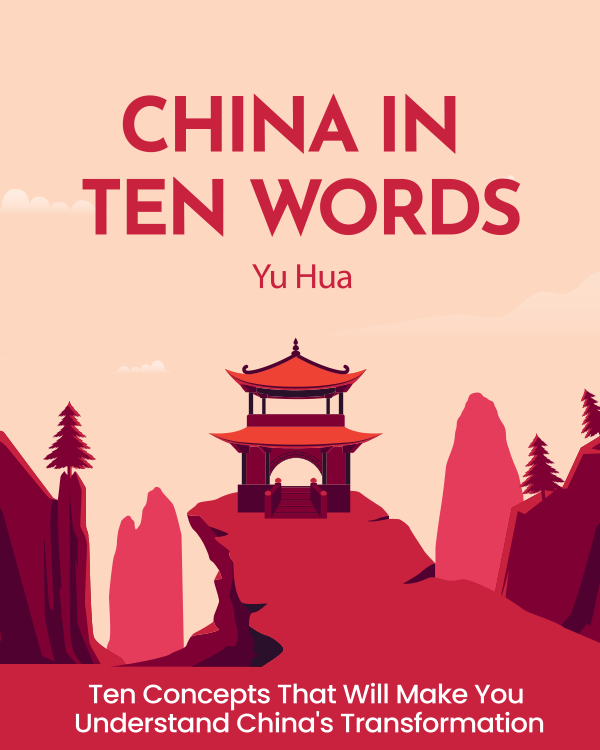
China In Ten WordsChina In Ten Words
China In Ten Words

China In Ten Words

user-icon

Yu Hua

Since the 1960s, China has undergone significant transformations. The turbulence of the Cultural Revolution has transitioned into consistent economic progress, and Mao's autocracy has been succeeded by a more reserved, collective leadership. Despite these changes, there are notable similarities between the two eras. Language, in its evolution and its enduring elements, provides an insightful way to unearth these connections. The Chinese vocabulary, from traditional terms like "reading" and "the people," to modern phrases like "bamboozling" and "copycat," offers intriguing insights into the country's history, current state, and potential future.

hashtaghistorical
hashtagpolitics
hashtagmemoir
hashtagchina
clock17 мин
bite10 Bite
target Инсайт

О чём это?

China in Ten Words delves into how contemporary China portrays itself and investigates the insights this provides about its history, current state, and potential future. By focusing on ten key concepts, the author, Yu Huan, narrates the transformation of a country that appears to have undergone drastic changes but still maintains strong ties to its revolutionary past in many aspects.

Резюме книги

Having worked as a dentist for five years, Yu Hua transitioned to become a writer in 1983 due to her aversion to "examining people's mouths all day." Her upbringing during the Cultural Revolution is evident in many of her stories and novels, reflecting the impact of that period on her life.

Since the 1960s, China has undergone significant transformations. The turbulence of the Cultural Revolution has transitioned into consistent economic progress, and Mao's autocracy has been succeeded by a more reserved, collective leadership. Despite these changes, there are notable similarities between the two eras. Language, in its evolution and its enduring elements, provides an insightful way to unearth these connections. The Chinese vocabulary, from traditional terms like "reading" and "the people," to modern phrases like "bamboozling" and "copycat," offers intriguing insights into the country's history, current state, and potential future.

"Perhaps nothing in the world creates a greater bond between people than pain, because it comes from the depths of the heart."

“The more boldly a man dares, the more richly his land bears”

“That is the real tragedy: poverty and hunger are not as shocking as willful indifference to them.”

Чтобы прочитать остальную часть книги, скачайте Bitely
appstoregoogleplayapp gallery
Все кусочки
bite10 Bites

The notion of "the people" was a pivotal ideology in modern China until the Tiananmen Square protests.

1
logo

The figure of a leader was epitomized by Mao, but the term lost much of its meaning since his demise.

2
logo

The significance of the term "reading" illustrates how the role of books has evolved since the Cultural Revolution.

3
logo

During the Cultural Revolution, writing became an integral part of Yu's persona.

4
logo

Lu Xun was one of the few authors that Yu read in his younger years, but it wasn't until later that he truly began to value Lu Xun's writing.

5
logo

Revolution has been a defining factor in Chinese history from the mid-20th century to the present day.

6
logo

The economic disparity in modern China is a critical aspect to understand its current societal dynamics.

7
logo

The idea of "grassroots" individuals advancing socially reflects the principles of the Cultural Revolution.

8
logo

"Copycat," known as shanzhai in China, is a term that has a deep-rooted history.

9
logo

"Bamboozle", a term signifying deception, is gaining popularity in modern China.

10
logo

Связанные книги

mailbox-icon

Хотите продолжать учиться?

Не пропустите обновления из захватывающей вселенной Bitely!