Biography & History
Capital and IdeologyCapital and Ideology

Capital and Ideology

user-icon

Thomas Piketty

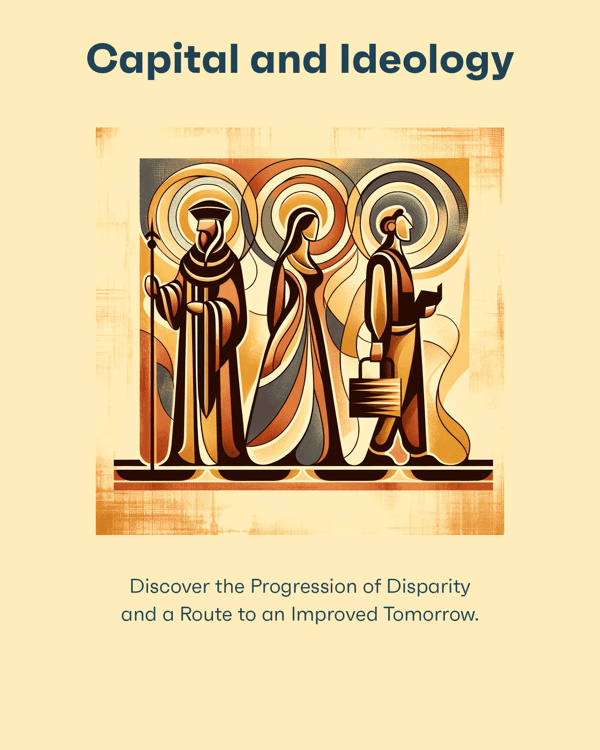
The three-part division of ternary societies, rooted in the roles of clergy, nobility, and commoners, was upheld by ideologies emphasizing societal stability through assigned functions. Medieval texts reinforced this structure, fostering acceptance among laborers and balance among elites, which contributed to the decline of serfdom and the rise of free labor in pre-Black Plague Western Europe. Debates, such as Sieyès's in 1789 France, revealed the complexities of these systems, where diminishing clergy and nobility populations retained significant wealth and influence, shaping doctrines to protect their status. The Catholic Church’s vast landholdings and resource management exemplified the sophisticated mechanisms that some argue laid the foundation for modern capitalism. Across regions like Europe, India, China, and the Islamic world, this tripartite system adapted over time, reflecting fluidity and negotiation. The emergence of modern states gradually reduced the clergy and nobility’s roles, with revolutionary contexts accelerating this shift. Despite their apparent rigidity, ternary societies allowed for social mobility, offering valuable insights into the historical roots of inequality and its enduring mechanisms, which continue to shape contemporary disparities in wealth and power.

clock3 мин
bite2 Bite
target Инсайт

О чём это?

The book delves into the intricate systems of power, property, and societal roles that shaped early ternary societies, where clergy, nobility, and commoners each played distinct roles in maintaining order. It explores how these structures, while appearing rigid, allowed for adaptation, negotiation, and even social mobility over time. By examining historical debates, strategies, and transitions—such as the decline of traditional roles with the rise of modern states—the narrative uncovers the enduring roots of inequality. Through this lens, the book offers a compelling framework for understanding how disparities in wealth and power have been justified and perpetuated throughout history.

Резюме книги

Thomas Piketty is a renowned French economist and professor, acclaimed for his extensive research and analysis on wealth and income inequality. He gained international fame for his groundbreaking work Capital in the Twenty-First Century, which rigorously examined the dynamics of income inequality in developed countries and sparked global discussions on economic disparities. His profound insights into economic structures and inequalities have established him as a pivotal figure in contemporary economics.

The three-part division of ternary societies, rooted in the roles of clergy, nobility, and commoners, was upheld by ideologies emphasizing societal stability through assigned functions. Medieval texts reinforced this structure, fostering acceptance among laborers and balance among elites, which contributed to the decline of serfdom and the rise of free labor in pre-Black Plague Western Europe. Debates, such as Sieyès's in 1789 France, revealed the complexities of these systems, where diminishing clergy and nobility populations retained significant wealth and influence, shaping doctrines to protect their status. The Catholic Church’s vast landholdings and resource management exemplified the sophisticated mechanisms that some argue laid the foundation for modern capitalism. Across regions like Europe, India, China, and the Islamic world, this tripartite system adapted over time, reflecting fluidity and negotiation. The emergence of modern states gradually reduced the clergy and nobility’s roles, with revolutionary contexts accelerating this shift. Despite their apparent rigidity, ternary societies allowed for social mobility, offering valuable insights into the historical roots of inequality and its enduring mechanisms, which continue to shape contemporary disparities in wealth and power.

Чтобы прочитать остальную часть книги, скачайте Bitely

appstoregoogleplayapp gallery
Все кусочки
bite2 Bites

Power, Property, and the Roots of Inequality

1
logo

Power, Property, and the Roots of Inequality

2
logo

Связанные книги

mailbox-icon

Хотите продолжать учиться?

Не пропустите обновления из захватывающей вселенной Bitely!