Self-Growth
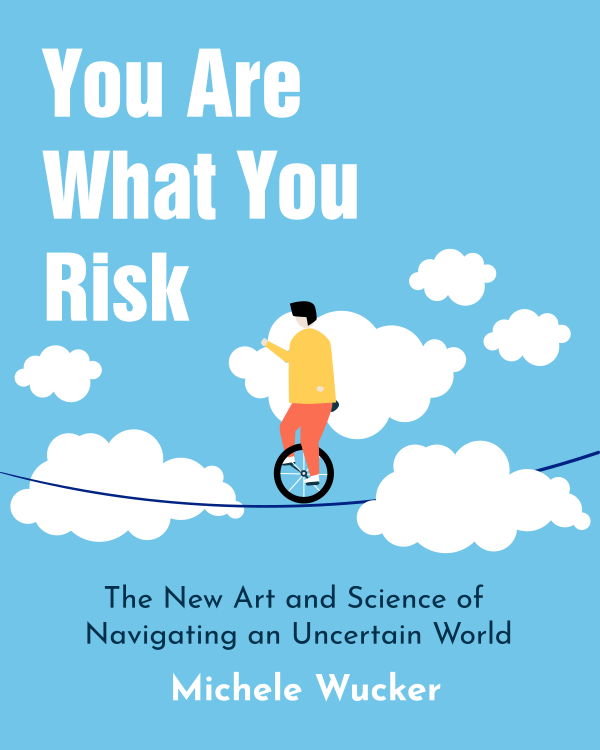
You Are What You RiskYou Are What You Risk

You Are What You Risk

user-icon

Michele Wucker

October of 2017 marked an unusual period for South Korea. President Donald Trump of the United States and leader Kim Jong-un of North Korea were in the midst of a tense verbal battle, putting the city of Seoul at risk. However, the South Korean citizens were preoccupied with a different matter: the removal of President Park Geun-hye due to corruption charges. The public's fascination with this issue was puzzling as the threat of a nuclear war loomed. The reason behind this was that South Koreans felt disconnected from the US-North Korea conflict, rendering it beyond their control. This situation highlighted the importance of a sense of purpose and involvement in recognizing risks. Attitudes towards risk change when individuals feel engaged, whether it's the risk of a nuclear conflict or financial instability. Historically, marginalized communities have struggled to secure business loans due to being perceived as high-risk borrowers. However, initiatives like the Boston Impact Initiative Fund are challenging this perception by not only providing loans but also a sense of purpose. Entrepreneur Deborah Frieze, who founded the fund, recognized the disparities in risk-taking opportunities for privileged and underprivileged individuals. She devised a system where interest rates for loans decrease as entrepreneurs are just starting, and extra protections are offered to those in need instead of the wealthiest investors. This approach emphasizes the interdependence of individuals in the business realm and how shared risks strengthen the overall system. Frieze's strategy underscores the significance of purpose-driven actions in contrast to the profit-centric focus of the current financial system. The deregulation of finance since the 1980s has prioritized risks to shareholder value, championed by economist Milton Friedman, while neglecting risks to stakeholder value. However, as awareness grows, people are realizing that risks take on a new perspective when considering the welfare of all parties involved.

clock8 min
bite6 Bite
target Aperçu

De quoi s'agit-il ?

The book "You Are What You Risk (2021)" delves into the concept of risk and its profound impact on one's life. It elucidates the intricate relationship between an individual and the myriad of elements that shape their perception and reaction towards risks.

Résumé du livre

Michele Wucker is a global strategist, speaker, and commentator whose book The Gray Rhino has been hugely influential in the world of finance and government. She gives speeches on leadership, crisis management, the economy, and other issues. Earlier in her career she was a financial journalist, and she has held leadership roles at the World Policy Institute and the Chicago Council on Global Affairs.

October of 2017 marked an unusual period for South Korea. President Donald Trump of the United States and leader Kim Jong-un of North Korea were in the midst of a tense verbal battle, putting the city of Seoul at risk. However, the South Korean citizens were preoccupied with a different matter: the removal of President Park Geun-hye due to corruption charges. The public's fascination with this issue was puzzling as the threat of a nuclear war loomed. The reason behind this was that South Koreans felt disconnected from the US-North Korea conflict, rendering it beyond their control. This situation highlighted the importance of a sense of purpose and involvement in recognizing risks. Attitudes towards risk change when individuals feel engaged, whether it's the risk of a nuclear conflict or financial instability. Historically, marginalized communities have struggled to secure business loans due to being perceived as high-risk borrowers. However, initiatives like the Boston Impact Initiative Fund are challenging this perception by not only providing loans but also a sense of purpose. Entrepreneur Deborah Frieze, who founded the fund, recognized the disparities in risk-taking opportunities for privileged and underprivileged individuals. She devised a system where interest rates for loans decrease as entrepreneurs are just starting, and extra protections are offered to those in need instead of the wealthiest investors. This approach emphasizes the interdependence of individuals in the business realm and how shared risks strengthen the overall system. Frieze's strategy underscores the significance of purpose-driven actions in contrast to the profit-centric focus of the current financial system. The deregulation of finance since the 1980s has prioritized risks to shareholder value, championed by economist Milton Friedman, while neglecting risks to stakeholder value. However, as awareness grows, people are realizing that risks take on a new perspective when considering the welfare of all parties involved.

Pour lire le reste du livre, téléchargez Bitely

appstoregoogleplayapp gallery
Toutes les bouchées
bite6 Bites

Individuals have their own distinct and intricate connections with risk.

1
logo

Danger exists everywhere, yet it can be interpreted in numerous ways.

2
logo

Your danger signature is a basic element of your character.

3
logo

Various demographic groups tend to exhibit varying risk preferences.

4
logo

People's tolerance for risk varies greatly depending on their individual backgrounds and characters.

5
logo

Being engaged with a clear goal increases your perception of danger.

6
logo

Livres associés

mailbox-icon

Voulez-vous continuer à apprendre ?

Ne manquez pas les mises à jour de l'univers passionnant de Bitely !