Self-Growth
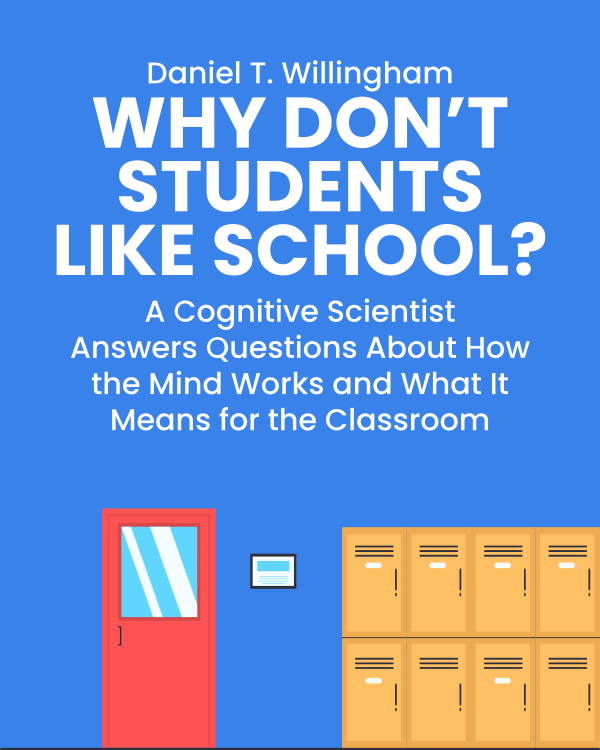
Why Don’t Students Like School?Why Don’t Students Like School?

Why Don’t Students Like School?

user-icon

Daniel T. Willingham

For a while, it was believed that children were born with their talents already determined; they were either athletic or smart, and that couldn't change. However, these beliefs have recently been questioned. In the debate between nature and nurture, nurture is now being given more importance. We understand now that intelligence is a combination of genetics and surroundings. Intelligence is based on the brain's potential. It has been proven that the brain can be changed. It's not to deny that children are born with varying levels of intelligence; it's just that those levels can be adjusted. But, it requires constant effort. But it doesn't end there. It appears that environmental aspects are more influential than genetics in determining intelligence. Until the 1980s, it was believed that environmental effects were limited. Recent proof has changed that notion. Since the 1930s, the average IQ in many countries has notably risen. For example, between 1952 and 1982, the average IQ of Dutch military recruits increased by 21 points. This rise in intelligence over the years is known as the Flynn effect, named after psychologist James Flynn. If we attempt to explain this change, genetics are not enough. The human gene pool doesn't change quickly enough for such a significant change in a short period. The environment seems to play a bigger role in intelligence than we previously thought. Intelligence is not the only area where environment can beat genetics. Amputees, for example, can learn to write with their non-dominant hand. But it takes practice to overcome the gene-based preference. Thinking of intelligence as unchangeable and determined by fate is discouraging for students. To challenge this, students must be shown that intelligence can be enhanced. This is where effective teaching becomes important.

clock9 min
bite6 Bite
target Aperçu

De quoi s'agit-il ?

Why Do Students Dislike School? The book Why Don’t Students Enjoy School? (2009) aims to elucidate the crucial cognitive operations involved in memory, acquisition of knowledge, and cognitive ability. A deeper comprehension of these mechanisms will empower educators to refine their pedagogical approaches, resulting in more captivating and fruitful educational initiatives.

Résumé du livre

Daniel T. Willingham is a cognitive psychologist who is a professor in the University of Virginia’s Department of Psychology. Daniel T. Willingham earned his PhD from Harvard University and has authored numerous books related to education and psychology. These include Cognition: The Thinking Animal (2001) and Raising Kids Who Read (2015).

For a while, it was believed that children were born with their talents already determined; they were either athletic or smart, and that couldn't change. However, these beliefs have recently been questioned. In the debate between nature and nurture, nurture is now being given more importance. We understand now that intelligence is a combination of genetics and surroundings. Intelligence is based on the brain's potential. It has been proven that the brain can be changed. It's not to deny that children are born with varying levels of intelligence; it's just that those levels can be adjusted. But, it requires constant effort. But it doesn't end there. It appears that environmental aspects are more influential than genetics in determining intelligence. Until the 1980s, it was believed that environmental effects were limited. Recent proof has changed that notion. Since the 1930s, the average IQ in many countries has notably risen. For example, between 1952 and 1982, the average IQ of Dutch military recruits increased by 21 points. This rise in intelligence over the years is known as the Flynn effect, named after psychologist James Flynn. If we attempt to explain this change, genetics are not enough. The human gene pool doesn't change quickly enough for such a significant change in a short period. The environment seems to play a bigger role in intelligence than we previously thought. Intelligence is not the only area where environment can beat genetics. Amputees, for example, can learn to write with their non-dominant hand. But it takes practice to overcome the gene-based preference. Thinking of intelligence as unchangeable and determined by fate is discouraging for students. To challenge this, students must be shown that intelligence can be enhanced. This is where effective teaching becomes important.

Pour lire le reste du livre, téléchargez Bitely

appstoregoogleplayapp gallery
Toutes les bouchées
bite6 Bites

Humans are not particularly skilled at reasoning, however, we excel at identifying patterns.

1
logo

Humans possess two equally significant forms of memory.

2
logo

Acquiring knowledge greatly depends on the environment in which it takes place.

3
logo

Storing factual information in your memory is essential for accomplishing more intricate undertakings.

4
logo

Children have similar learning processes rather than distinct ones.

5
logo

Intelligence levels are not fixed at birth for anyone.

6
logo

Livres associés

mailbox-icon

Voulez-vous continuer à apprendre ?

Ne manquez pas les mises à jour de l'univers passionnant de Bitely !