Self-Growth
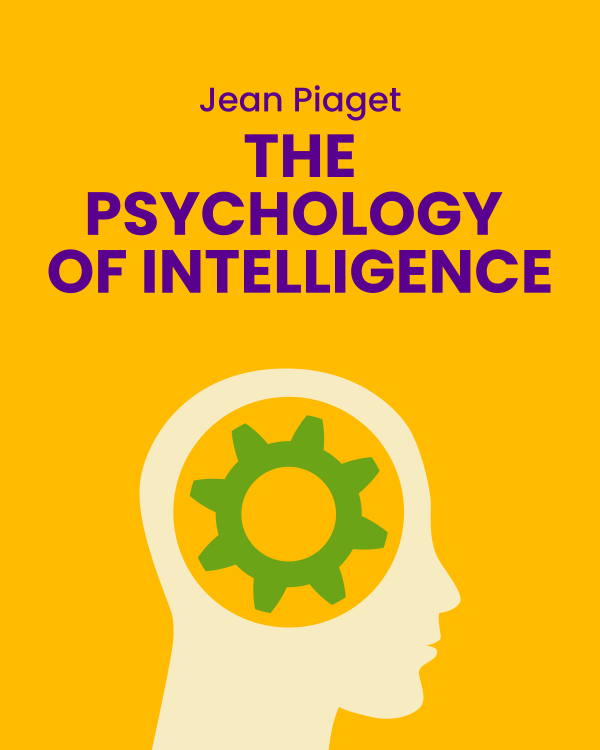
The Psychology of IntelligenceThe Psychology of Intelligence

The Psychology of Intelligence

user-icon

Jean Piaget

The core message of these summaries is that intelligence is dynamic. To comprehend the workings of the world, we must actively investigate it both literally and figuratively. Some things can be explained using our existing knowledge, while others cannot. In the first scenario, we incorporate new information, while in the latter, we adjust our understanding. These methods show how we adapt intellectually to our surroundings, leading us through four cognitive development phases until we reach maturity in early adolescence. Do you have any comments? We would appreciate hearing your opinions on our content! Simply send an email to [email protected] with The Psychology of Intelligence as the subject, and share your feedback! If you're looking for further reading, consider checking out Ungifted: Intelligence Redefined by Scott Barry Kaufman. Piaget's ideas, like those of all revolutionary thinkers, continue to influence how psychologists explore intelligence. However, this doesn't mean his theories are definitive. Recent experimental studies have broadened, refined, and questioned his notions of cognitive development. So, what is the current status in this field? Who could provide better insight than American cognitive psychologist Scott Barry Kaufman, the author of a comprehensive examination of varying intelligence theories and their impact on our well-being? For more information, explore our summaries on Intelligence Redefined! Interested in sharing with your team? Keep in mind that we offer company subscriptions. Click the link below or connect with your Learning & Development department to learn how you and your team can benefit from for personal and professional growth.

clock17 min
bite9 Bite
target Aperçu

De quoi s'agit-il ?

Jean Piaget's groundbreaking theory of intelligence and cognitive development from birth to adolescence is explored in his book "The Psychology of Intelligence" (1947). These lectures, originally given in Paris, offer valuable insights into Piaget's influential research and the significant contributions he made to the field of child psychology during the twentieth century.

Résumé du livre

Jean Piaget was a Swiss psychologist best known for his contributions to the study of child development. Born in 1896, he authored over 50 books on cognitive development before his death in 1980. His ideas continue to shape debate and guide the work of psychologists, sociologists, and educationalists.

The core message of these summaries is that intelligence is dynamic. To comprehend the workings of the world, we must actively investigate it both literally and figuratively. Some things can be explained using our existing knowledge, while others cannot. In the first scenario, we incorporate new information, while in the latter, we adjust our understanding. These methods show how we adapt intellectually to our surroundings, leading us through four cognitive development phases until we reach maturity in early adolescence. Do you have any comments? We would appreciate hearing your opinions on our content! Simply send an email to [email protected] with The Psychology of Intelligence as the subject, and share your feedback! If you're looking for further reading, consider checking out Ungifted: Intelligence Redefined by Scott Barry Kaufman. Piaget's ideas, like those of all revolutionary thinkers, continue to influence how psychologists explore intelligence. However, this doesn't mean his theories are definitive. Recent experimental studies have broadened, refined, and questioned his notions of cognitive development. So, what is the current status in this field? Who could provide better insight than American cognitive psychologist Scott Barry Kaufman, the author of a comprehensive examination of varying intelligence theories and their impact on our well-being? For more information, explore our summaries on Intelligence Redefined! Interested in sharing with your team? Keep in mind that we offer company subscriptions. Click the link below or connect with your Learning & Development department to learn how you and your team can benefit from for personal and professional growth.

Pour lire le reste du livre, téléchargez Bitely

appstoregoogleplayapp gallery
Toutes les bouchées
bite9 Bites

Intelligence is behavior.

1
logo

Interactions between organisms and their environments are governed by adaptation.

2
logo

We structure information to adjust mentally to our surroundings.

3
logo

Cognitive progress is fueled by the processes of intellectual absorption and adjustment.

4
logo

The quest for balance guides us along specific phases of cognitive growth.

5
logo

During the initial phase of growth, babies come to realize the presence of separate entities.

6
logo

In the preoperational stage of development, children exhibit egocentric behaviors.

7
logo

Children enter the third stage of development when they acquire a deep understanding of conservation, reversibility, and classification principles.

8
logo

As it grows older, thinking becomes more conceptual.

9
logo

Livres associés

mailbox-icon

Voulez-vous continuer à apprendre ?

Ne manquez pas les mises à jour de l'univers passionnant de Bitely !