Self-Growth
The Great Mental ModelsThe Great Mental Models

The Great Mental Models

user-icon

Shane Parrish and Rhiannon Beaubien

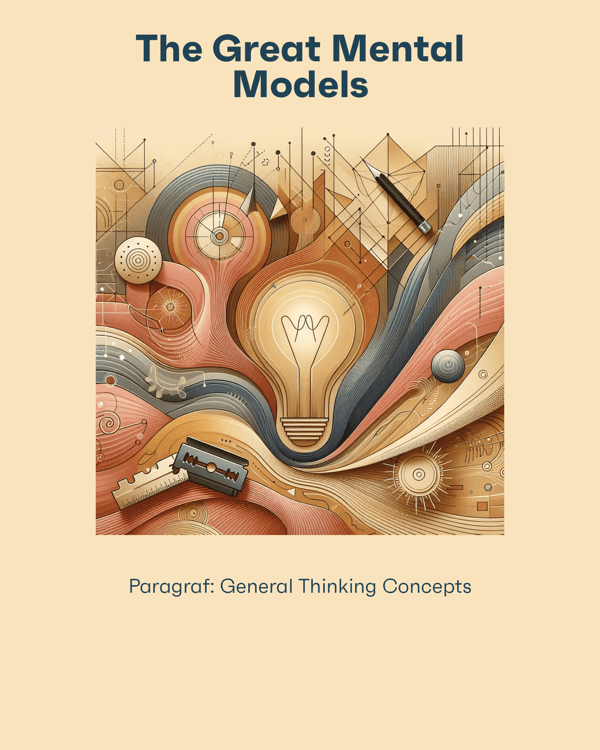
Practical knowledge is like a vast landscape navigated with tools such as maps, representing our circle of competence—the skills we master through effort and practice. Recognizing the boundaries of this circle is crucial; within it, we act with confidence, but outside it, we risk overconfidence and mistakes. Mental models like Hanlon’s razor remind us to favor ignorance over malice when interpreting others’ actions, while Occam’s razor encourages simpler explanations for complex problems. Creativity and first-principle reasoning help us break down challenges to their core, fostering innovation. Tools like thought experiments allow us to test ideas safely and explore values, as seen in scenarios like Einstein’s gravity insights or imagining life without financial constraints. Techniques like inversion, used by Edward Bernays, reveal unconventional solutions by flipping perspectives, while maps—both literal and metaphorical—simplify complex realities, though they require awareness of their omissions. Second-order thinking highlights the broader consequences of decisions, such as the risks of antibiotic overuse or the societal benefits of women’s rights. Probabilistic thinking, supported by Bayesian updating, helps balance fear-driven reactions with rational assessments, enabling us to adapt to new information and navigate an ever-changing world effectively.

clock12 min
bite9 Bite
target Aperçu

De quoi s'agit-il ?

This book explores the art of navigating the vast landscape of knowledge, emphasizing the importance of understanding your strengths, recognizing your limits, and thinking critically. It delves into mental models like Occam’s and Hanlon’s razors, first-principle reasoning, and inversion to foster creativity and problem-solving. Through engaging examples and thought experiments, it highlights how to make better decisions, avoid cognitive traps, and uncover innovative solutions. With practical insights on everything from leveraging expertise to embracing probabilistic thinking, this guide equips readers to approach challenges with clarity and confidence.

Résumé du livre

Shane Parrish is a former cybersecurity expert who worked for the Communications Security Establishment (CSE) – an agency of Canada’s Department of National Defence. He is host of The Knowledge Project podcast and the founder of Farnam Street – an online learning community and blog. Rhiannon Beaubien is also a former member of the CSE and writes for Farnam Street’s blog.

Practical knowledge is like a vast landscape navigated with tools such as maps, representing our circle of competence—the skills we master through effort and practice. Recognizing the boundaries of this circle is crucial; within it, we act with confidence, but outside it, we risk overconfidence and mistakes. Mental models like Hanlon’s razor remind us to favor ignorance over malice when interpreting others’ actions, while Occam’s razor encourages simpler explanations for complex problems. Creativity and first-principle reasoning help us break down challenges to their core, fostering innovation. Tools like thought experiments allow us to test ideas safely and explore values, as seen in scenarios like Einstein’s gravity insights or imagining life without financial constraints. Techniques like inversion, used by Edward Bernays, reveal unconventional solutions by flipping perspectives, while maps—both literal and metaphorical—simplify complex realities, though they require awareness of their omissions. Second-order thinking highlights the broader consequences of decisions, such as the risks of antibiotic overuse or the societal benefits of women’s rights. Probabilistic thinking, supported by Bayesian updating, helps balance fear-driven reactions with rational assessments, enabling us to adapt to new information and navigate an ever-changing world effectively.

Pour lire le reste du livre, téléchargez Bitely

appstoregoogleplayapp gallery
Toutes les bouchées
bite9 Bites

Mastering Complexity Through Simplified Perspectives

1
logo

Mastering Your Circle of Competence

2
logo

Unlocking Innovation Through First Principles

3
logo

Reversing the Rules to Solve Problems

4
logo

Unlocking Creativity Through Thought Experiments

5
logo

Mastering Decisions Through Second-Order Thinking

6
logo

Mastering Decisions with Probabilistic Thinking

7
logo

Choosing Clarity: Simplifying Complex Decisions

8
logo

Choose Simplicity Over Assumptions in Missteps

9
logo

Livres associés

mailbox-icon

Voulez-vous continuer à apprendre ?

Ne manquez pas les mises à jour de l'univers passionnant de Bitely !