Politics & Society
On TyrannyOn Tyranny

On Tyranny

user-icon

Timothy Snyder

Even for those disinterested in politics, the pervasive slogans and catchphrases of politicians are hard to ignore. George Orwell’s *1984* warns of the dangers of losing independent thought to manipulative language, showing how restrictive media and the systematic removal of words can erode critical thinking and resistance. To counter this, individuals must actively cultivate their own ideas, avoid programmed thinking, and diversify their sources of information. Books, unlike media, offer depth, context, and diverse perspectives, fostering independent thought and moral understanding. Privacy is another cornerstone of freedom; its erosion, as seen in the 2016 U.S. election email leaks, can destabilize democracy. The media’s focus on gossip and conspiracy theories often distracts from pressing political issues, a phenomenon noted by philosopher Hannah Arendt. Protecting privacy and resisting authoritarian tactics, such as the normalization of exclusionary symbols or propaganda, is essential. Historical examples, from Nazi Germany’s boycotts to Vaclav Havel’s critique of compliance under Communism, illustrate how passive acceptance strengthens oppressive regimes. The distortion of truth, as seen in the "post-truth" era, undermines freedom through repeated lies, contradictions, and misplaced trust in leaders. Resistance requires vigilance, connection, and unity across social divides, as demonstrated by Poland’s Solidarity movement, which successfully opposed Communism through coalition-building. In the U.S., the concentration of power within one party and the rise of paramilitary forces demand attention, as history shows that internal threats often dismantle democracies. Active participation in elections and safeguarding democratic processes are critical to preserving freedom.

clock11 min
bite6 Bite
target Aperçu

De quoi s'agit-il ?

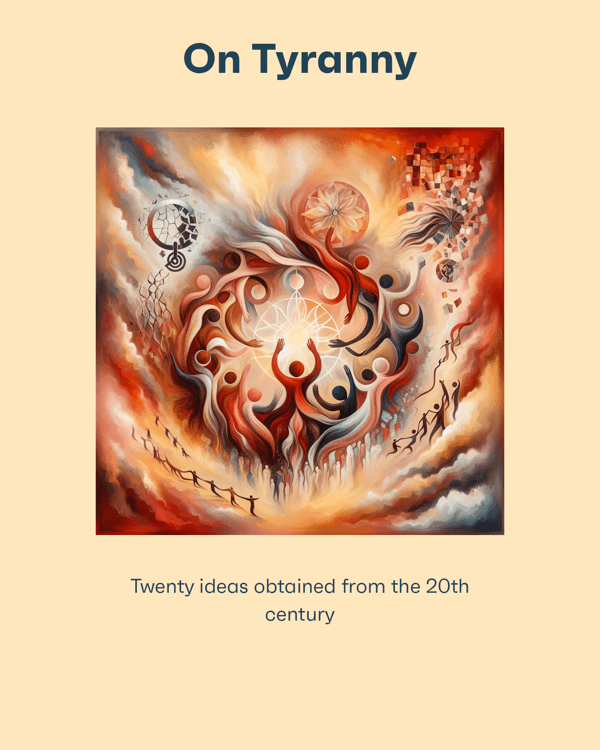
This book delves into the critical importance of independent thought in an era dominated by media manipulation, political propaganda, and the erosion of privacy. Drawing on historical events, literary works like *1984*, and modern examples, it explores how language, misinformation, and societal complacency can pave the way for authoritarianism. Through vivid storytelling and analysis, it emphasizes the power of books, diverse perspectives, and human connection in resisting tyranny and safeguarding democracy. Ultimately, it is a call to action for vigilance, critical thinking, and the protection of fundamental freedoms.

Résumé du livre

A professor at Yale University, Timothy Snyder specializes in European history and the Holocaust and has written several award-winning books, including The Reconstruction of Nations and The Red Prince.

Even for those disinterested in politics, the pervasive slogans and catchphrases of politicians are hard to ignore. George Orwell’s *1984* warns of the dangers of losing independent thought to manipulative language, showing how restrictive media and the systematic removal of words can erode critical thinking and resistance. To counter this, individuals must actively cultivate their own ideas, avoid programmed thinking, and diversify their sources of information. Books, unlike media, offer depth, context, and diverse perspectives, fostering independent thought and moral understanding. Privacy is another cornerstone of freedom; its erosion, as seen in the 2016 U.S. election email leaks, can destabilize democracy. The media’s focus on gossip and conspiracy theories often distracts from pressing political issues, a phenomenon noted by philosopher Hannah Arendt. Protecting privacy and resisting authoritarian tactics, such as the normalization of exclusionary symbols or propaganda, is essential. Historical examples, from Nazi Germany’s boycotts to Vaclav Havel’s critique of compliance under Communism, illustrate how passive acceptance strengthens oppressive regimes. The distortion of truth, as seen in the "post-truth" era, undermines freedom through repeated lies, contradictions, and misplaced trust in leaders. Resistance requires vigilance, connection, and unity across social divides, as demonstrated by Poland’s Solidarity movement, which successfully opposed Communism through coalition-building. In the U.S., the concentration of power within one party and the rise of paramilitary forces demand attention, as history shows that internal threats often dismantle democracies. Active participation in elections and safeguarding democratic processes are critical to preserving freedom.

Pour lire le reste du livre, téléchargez Bitely

appstoregoogleplayapp gallery
Toutes les bouchées
bite6 Bites

Defending Democracy: Guarding Against Internal Threats

1
logo

Resisting Oppression: The Power of Refusal

2
logo

Defying Tyranny: The Power of Independent Thought

3
logo

Building Bridges: Resisting Tyranny Through Unity

4
logo

Guarding Privacy: The Key to Preserving Freedom

5
logo

Truth Under Siege: Resisting the Erosion of Freedom

6
logo

Livres associés

mailbox-icon

Voulez-vous continuer à apprendre ?

Ne manquez pas les mises à jour de l'univers passionnant de Bitely !