
Biography & History
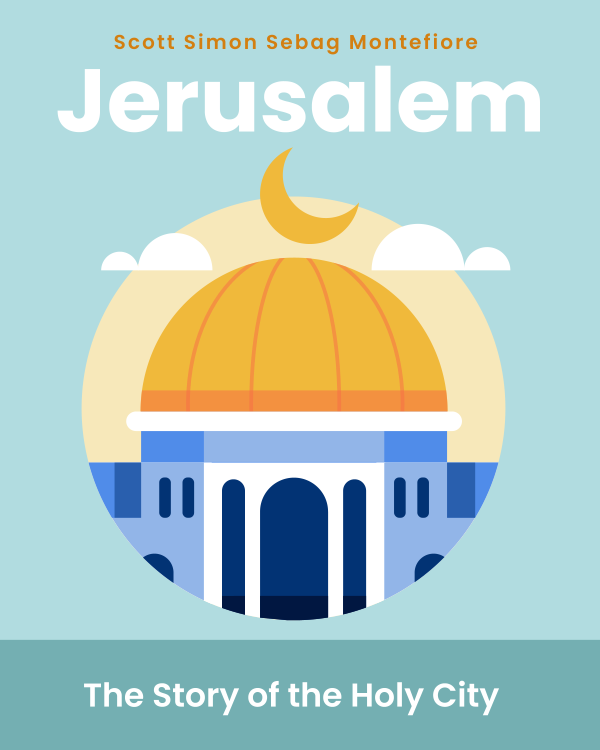
JerusalemJerusalem
Jerusalem

Jerusalem

user-icon

Simon Sebag Montefiore

The historical narrative of Jerusalem provides a compelling perspective on the significant influence of religion in shaping human civilization. It suggests that while cycles of violent conflict may seem eternal, there remains optimism that people of different religious backgrounds can eventually live together harmoniously.

hashtagmiddle-east
clock35 min
bite16 Bite
target Aperçu

De quoi s'agit-il ?

Jerusalem tells the story of a city revered as holy by three major world religions and at the center of many significant conflicts throughout history. These bites provide a glimpse into Jerusalem's history, its constant warfare, and its profound influence on shaping human civilization through the ages.

Résumé du livre

Simon Sebag Montefiore is a British historian, author and television presenter, known for his work in historical non-fiction and historical fiction. He has written extensively on various historical periods, with a focus on Russia and the Middle East.

The historical narrative of Jerusalem provides a compelling perspective on the significant influence of religion in shaping human civilization. It suggests that while cycles of violent conflict may seem eternal, there remains optimism that people of different religious backgrounds can eventually live together harmoniously.

“The greatest privilege of childhood is to live totally in the present.”

“What's important is not who YOU love but WHO loves you.”

“Every love story is a requiem.”

Pour lire le reste du livre, téléchargez Bitely
appstoregoogleplayapp gallery
Toutes les bouchées
bite16 Bites

Jerusalem's history dates back to around 5000 BC, with the arrival of the Israelites occurring some 4000 years later.

1
logo

Jerusalem's earliest two temples served as a pathway to God and were central to the development of Judaism.

2
logo

During a period of great unrest, Jesus came into the world, and as a result, he experienced crucifixion and a highly debated resurrection.

3
logo

The emperor of Rome commanded a military assault on Jerusalem, which ultimately resulted in the destruction of the second temple.

4
logo

The Romans embraced Christianity and built their empire based on this faith.

5
logo

Muhammad orchestrated a pilgrimage of his followers to Jerusalem, imbued with spiritual significance.

6
logo

The destruction of Jerusalem during the First Crusade shattered attempts for Muslim unification.

7
logo

Muslim uprising resulted in the following crusades and an ongoing conflict over Jerusalem.

8
logo

Jerusalem was rebuilt after it was retaken by an army of slave soldiers.

9
logo

Following the Mamluks, the Ottomans ruled over Jerusalem and the city expanded.

10
logo

Hopes for Jewish and Arab independence arose around the turn of the twentieth century.

11
logo

Tensions in Jerusalem rose after World War I as a result of several international treaties.

12
logo

The years following World War I were marked by rising extremism and violence.

13
logo

The Battle of Jerusalem in 1948 was the result of escalating violence.

14
logo

An enraged Egyptian President sparked a brief conflict, resulting in a decisive victory for Israel.

15
logo

The situation in Jerusalem remains complicated.

16
logo

Livres associés

mailbox-icon

Voulez-vous continuer à apprendre ?

Ne manquez pas les mises à jour de l'univers passionnant de Bitely !