Self-Growth
InnumeracyInnumeracy

Innumeracy

user-icon

John Allen Paulos

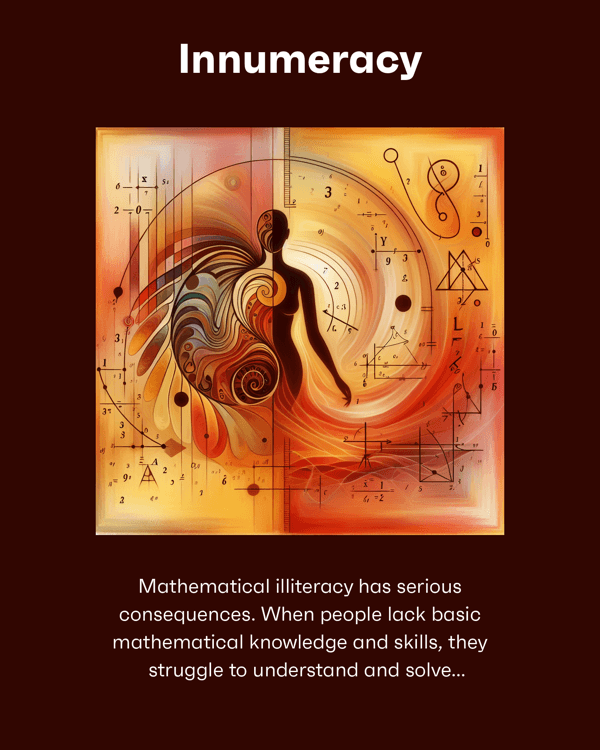
The prevalence of innumeracy stems from both ineffective teaching methods and psychological barriers. While schools often focus on abstract equations, they fail to connect math to real-life applications, leaving students disengaged. Math anxiety, born from negative experiences, further alienates individuals, though gradual exposure to simpler problems can rebuild confidence. Misconceptions about math as rigid or uncreative also contribute to its unpopularity, despite its critical role in decision-making and understanding societal behaviors. Innumeracy has real-world consequences, from irrational fears—like overestimating rare events—to an inability to grasp basic principles like the multiplication rule, which explains how a small wardrobe can yield millions of outfit combinations. Mathematics also clarifies trade-offs, such as weighing statistical errors in decisions, and helps avoid everyday mistakes, like misunderstanding compounded discounts. Beyond practical uses, math demystifies coincidences, showing how improbable events are statistically inevitable, as illustrated by legal cases and phenomena like the birthday paradox. However, math’s authoritative image also makes it a tool for pseudoscience, such as astrology, which distorts principles like gravity for unfounded claims. Even intellectuals like Freud fell for numerical fallacies, highlighting how easily math can be misused to deceive the innumerate.

clock9 min
bite5 Bite
target Aperçu

De quoi s'agit-il ?

This book delves into the pervasive issue of innumeracy, exploring how flawed teaching methods, psychological barriers like math anxiety, and widespread misconceptions contribute to a lack of basic mathematical understanding. Through engaging examples, it highlights the practical relevance of math in decision-making, societal behavior, and everyday life, while also exposing the dangers of pseudoscience and the misuse of mathematical concepts. With a lively and thought-provoking approach, it underscores the importance of numerical literacy in navigating both the mundane and the extraordinary aspects of the world.

Résumé du livre

John Allen Paulos is a Professor of Mathematics at Temple University in Philadelphia. He is the author of many other books, including A Mathematician Reads the Newspaper, and has written for publications such as The New York Times and ABCNEWS.com.

The prevalence of innumeracy stems from both ineffective teaching methods and psychological barriers. While schools often focus on abstract equations, they fail to connect math to real-life applications, leaving students disengaged. Math anxiety, born from negative experiences, further alienates individuals, though gradual exposure to simpler problems can rebuild confidence. Misconceptions about math as rigid or uncreative also contribute to its unpopularity, despite its critical role in decision-making and understanding societal behaviors. Innumeracy has real-world consequences, from irrational fears—like overestimating rare events—to an inability to grasp basic principles like the multiplication rule, which explains how a small wardrobe can yield millions of outfit combinations. Mathematics also clarifies trade-offs, such as weighing statistical errors in decisions, and helps avoid everyday mistakes, like misunderstanding compounded discounts. Beyond practical uses, math demystifies coincidences, showing how improbable events are statistically inevitable, as illustrated by legal cases and phenomena like the birthday paradox. However, math’s authoritative image also makes it a tool for pseudoscience, such as astrology, which distorts principles like gravity for unfounded claims. Even intellectuals like Freud fell for numerical fallacies, highlighting how easily math can be misused to deceive the innumerate.

Pour lire le reste du livre, téléchargez Bitely

appstoregoogleplayapp gallery
Toutes les bouchées
bite5 Bites

Mastering Numbers: Why Math Matters

1
logo

Decoding Coincidences: The Math Behind the Unexpected

2
logo

Exposing the Myths Behind Misused Mathematics

3
logo

Making Math Meaningful: Overcoming Innumeracy and Anxiety

4
logo

Mastering Decisions Through Mathematical Insight

5
logo

Livres associés

mailbox-icon

Voulez-vous continuer à apprendre ?

Ne manquez pas les mises à jour de l'univers passionnant de Bitely !