Politics & Society
HumankindHumankind

Humankind

user-icon

Rutger Bregman

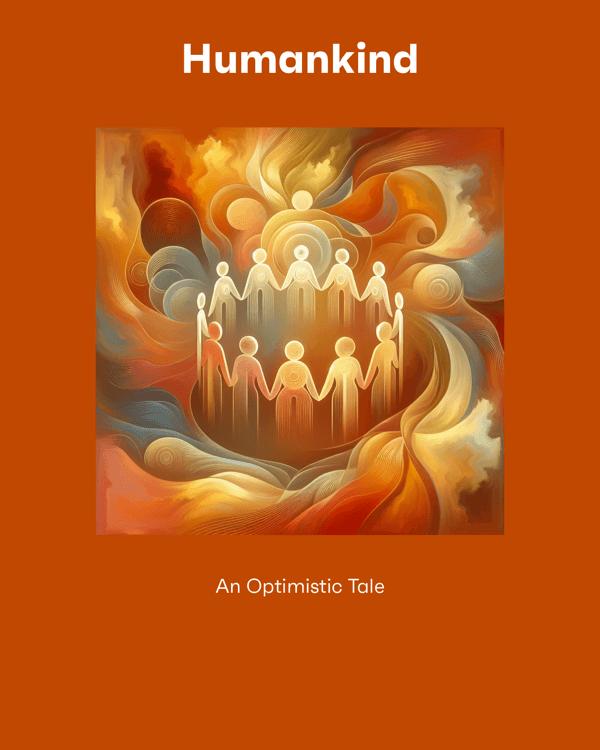
The phrase "Stay Calm and Move Forward," now a pop culture staple, originated as a World War II slogan by the British Ministry of Information to inspire resilience. While often associated with British identity, the ability to remain composed under pressure is a universal human trait, as seen in moments like the September 11 attacks, where unity triumphed over chaos. This challenges long-standing philosophical debates about human nature, such as Hobbes's view of inherent selfishness versus Rousseau's belief in innate goodness corrupted by society. Historical and archaeological evidence suggests violence emerged with the advent of property and social hierarchies, contrasting with the cooperative spirit of early hunter-gatherer societies. Even in war, humans display a reluctance to harm others, as seen in soldiers' hesitations to kill and moments of shared humanity, like the Christmas truce of 1914. However, empathy, while fostering connection, has its limits, often excluding those outside our immediate circle. Media and fiction further skew perceptions of human nature, amplifying negativity and pessimism. Yet, real-life examples, such as the cooperative behavior of stranded children in contrast to the chaos of *Lord of the Flies*, suggest humanity's capacity for kindness and collaboration may be more intrinsic than we assume.

clock15 min
bite8 Bite
target Aperçu

De quoi s'agit-il ?

What drives human behavior in times of crisis? This book explores the age-old debate about whether humans are inherently good or bad, challenging assumptions with evidence from history, philosophy, and science. From the resilience of Londoners during the Blitz to the camaraderie of soldiers in war, it examines how empathy, cooperation, and societal structures shape our actions. Through engaging stories and surprising insights, it reveals a more hopeful perspective on human nature, while acknowledging its complexities.

Résumé du livre

Rutger Bregman, born in the Netherlands in 1988, proves that a historian can also be a best-selling author. In his 2017 book Utopias for Realists, Bregman made the case for a universal basic income, open borders, and a 15-hour workweek. He’s also known for ruffling feathers at the World Economic Summit in Davos, in 2019, where he called out billionaires for tax avoidance.

The phrase "Stay Calm and Move Forward," now a pop culture staple, originated as a World War II slogan by the British Ministry of Information to inspire resilience. While often associated with British identity, the ability to remain composed under pressure is a universal human trait, as seen in moments like the September 11 attacks, where unity triumphed over chaos. This challenges long-standing philosophical debates about human nature, such as Hobbes's view of inherent selfishness versus Rousseau's belief in innate goodness corrupted by society. Historical and archaeological evidence suggests violence emerged with the advent of property and social hierarchies, contrasting with the cooperative spirit of early hunter-gatherer societies. Even in war, humans display a reluctance to harm others, as seen in soldiers' hesitations to kill and moments of shared humanity, like the Christmas truce of 1914. However, empathy, while fostering connection, has its limits, often excluding those outside our immediate circle. Media and fiction further skew perceptions of human nature, amplifying negativity and pessimism. Yet, real-life examples, such as the cooperative behavior of stranded children in contrast to the chaos of *Lord of the Flies*, suggest humanity's capacity for kindness and collaboration may be more intrinsic than we assume.

Pour lire le reste du livre, téléchargez Bitely

appstoregoogleplayapp gallery
Toutes les bouchées
bite8 Bites

Resilience Under Fire: How London Defied Chaos

1
logo

Resilience Revealed: Humanity’s Strength in Crisis

2
logo

Why We Misjudge Humanity’s True Nature

3
logo

Rethinking Human Nature: Beyond Hobbes and Violence

4
logo

How Cooperation Shaped Humanity's Survival

5
logo

How Civilization Sparked Humanity's Turn to Violence

6
logo

The Paradox of Empathy in Human Nature

7
logo

Empathy's Paradox: Humanity in Times of War

8
logo

Livres associés

mailbox-icon

Voulez-vous continuer à apprendre ?

Ne manquez pas les mises à jour de l'univers passionnant de Bitely !