Biography & History
Get Well SoonGet Well Soon
Get Well Soon

Get Well Soon

user-icon

Jennifer Wright

Humanity has been plagued with numerous deadly diseases throughout history. While these stories can be captivating, it's equally crucial to draw lessons from our past. Governments and communities should remain vigilant about potential threats, and when diseases do emerge, officials must react with openness, empathy, and science-backed remedies. In such circumstances, superstition, bias, or censorship have no place. Leaving raw onions around your house won't prevent diseases. In the past, due to the misconception that foul odors were responsible for the spread of the bubonic plague, some individuals believed that placing onions in their homes would improve indoor air quality and ward off the plague. This practice proved to be ineffective, yet surprisingly, beliefs regarding the health benefits of chopped onions persist to this day. As an example, the National Onion Association has a dedicated section in their FAQ on their website, explicitly stating that putting chopped onions around your house does not protect you from the disease!

hashtagscience
hashtagmedical
clock13 min
bite6 Bite
target Aperçu

De quoi s'agit-il ?

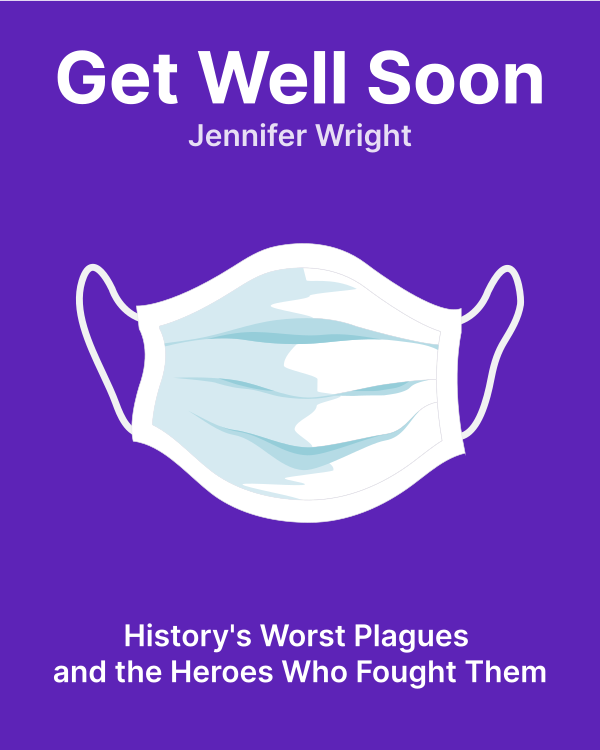
Get Well Soon provides an overview of human diseases and epidemics spanning from ancient times to the twentieth century, delving into the historical perspectives on various diseases and their treatments. The book also features people who contributed to the prevention and treatment of diseases, along with those who helped marginalized individuals afflicted by disease.

Résumé du livre

Jennifer Wright, renowned for her six well-received history books, has contributed to publications such as the New York Times, the New York Post, and the New York Observer. Nevertheless, she resides in Los Angeles with her husband, Daniel Kibblesmith, and their daughter.

Humanity has been plagued with numerous deadly diseases throughout history. While these stories can be captivating, it's equally crucial to draw lessons from our past. Governments and communities should remain vigilant about potential threats, and when diseases do emerge, officials must react with openness, empathy, and science-backed remedies. In such circumstances, superstition, bias, or censorship have no place. Leaving raw onions around your house won't prevent diseases. In the past, due to the misconception that foul odors were responsible for the spread of the bubonic plague, some individuals believed that placing onions in their homes would improve indoor air quality and ward off the plague. This practice proved to be ineffective, yet surprisingly, beliefs regarding the health benefits of chopped onions persist to this day. As an example, the National Onion Association has a dedicated section in their FAQ on their website, explicitly stating that putting chopped onions around your house does not protect you from the disease!

“Telling people that things are fine is not the same as making them fine.”

“It is telling that, historically, quarantines extended primarily to those who had less wealth, power, and social clout.”

“After all, the past was no less ridiculous than the present. Both eras were made up of humans.”

Pour lire le reste du livre, téléchargez Bitely

appstoregoogleplayapp gallery
Toutes les bouchées
bite6 Bites

Saint Vitus shouldn’t be the inspiration for your dance moves.

1
logo

Nobody understood the cause of the plague, and it was often treated in an odd way.

2
logo

Spanish colonialists received assistance in their conquests from the smallpox virus.

3
logo

Compassion, not isolation, offers support to individuals affected with leprosy.

4
logo

To prevent cholera, keep your water source separate from your sewage trench.

5
logo

Censorship can have fatal consequences, as demonstrated by the Spanish flu.

6
logo

Livres associés

mailbox-icon

Voulez-vous continuer à apprendre ?

Ne manquez pas les mises à jour de l'univers passionnant de Bitely !