Biography & History
Destined for WarDestined for War

Destined for War

user-icon

Graham Allison

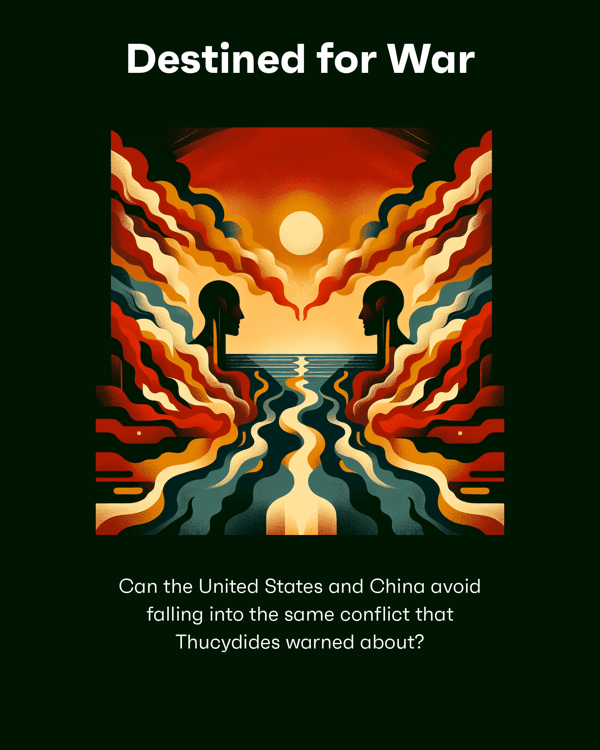
China's rapid rise and the United States' determination to maintain its global dominance mirror historical patterns of tension between rising and established powers, often culminating in conflict. Historical examples, such as Spain and Portugal's Treaty of Tordesillas, Britain's diplomatic response to America's ascent, and Cold War dynamics, reveal that peaceful resolutions are possible but rare. Potential flashpoints today include Taiwan's independence movement, territorial disputes in the South China Sea, North Korea's instability, and economic conflicts, all of which could escalate under current geopolitical conditions. Drawing parallels to the Peloponnesian War and other historical rivalries, the redistribution of power often destabilizes existing structures, transforming manageable disputes into major conflicts. As China continues its meteoric economic and industrial growth, challenging the U.S.-led global order, the question remains whether history will repeat itself or if diplomacy can avert the so-called Thucydides Trap.

clock20 min
bite4 Bite
target Aperçu

De quoi s'agit-il ?

China’s rapid rise and its challenge to the United States’ global dominance set the stage for a high-stakes power struggle that echoes historical patterns of rivalry. This book explores the dynamics of the so-called Thucydides Trap, where tensions between an emerging power and an established one often lead to conflict. Drawing on historical parallels, from the Peloponnesian War to modern geopolitical flashpoints, it examines the structural forces, potential triggers, and strategic choices that could shape the future of U.S.-China relations. Through a rich blend of historical analysis and contemporary insights, it delves into whether these two superpowers can avoid the pitfalls of history and find a path to peaceful coexistence.

Résumé du livre

Graham Allison is a renowned scholar, political scientist, and the Douglas Dillon Professor of Government at the John F. Kennedy School of Government at Harvard University. He serves as the Director of the Harvard Kennedy School’s Belfer Center for Science and International Affairs and leads Harvard University’s long-running Thucydides Trap Project.

China's rapid rise and the United States' determination to maintain its global dominance mirror historical patterns of tension between rising and established powers, often culminating in conflict. Historical examples, such as Spain and Portugal's Treaty of Tordesillas, Britain's diplomatic response to America's ascent, and Cold War dynamics, reveal that peaceful resolutions are possible but rare. Potential flashpoints today include Taiwan's independence movement, territorial disputes in the South China Sea, North Korea's instability, and economic conflicts, all of which could escalate under current geopolitical conditions. Drawing parallels to the Peloponnesian War and other historical rivalries, the redistribution of power often destabilizes existing structures, transforming manageable disputes into major conflicts. As China continues its meteoric economic and industrial growth, challenging the U.S.-led global order, the question remains whether history will repeat itself or if diplomacy can avert the so-called Thucydides Trap.

Pour lire le reste du livre, téléchargez Bitely

appstoregoogleplayapp gallery
Toutes les bouchées
bite4 Bites

Rival Powers: The Looming U.S.-China Clash

1
logo

Rivalry and Resurgence: Navigating the Thucydides Trap

2
logo

Sparks of Conflict: Navigating the US-China Rivalry

3
logo

Clash of Titans: Navigating U.S.-China Rivalry

4
logo

Livres associés

mailbox-icon

Voulez-vous continuer à apprendre ?

Ne manquez pas les mises à jour de l'univers passionnant de Bitely !