Biography & History
CapitalCapital

Capital

user-icon

Karl Marx

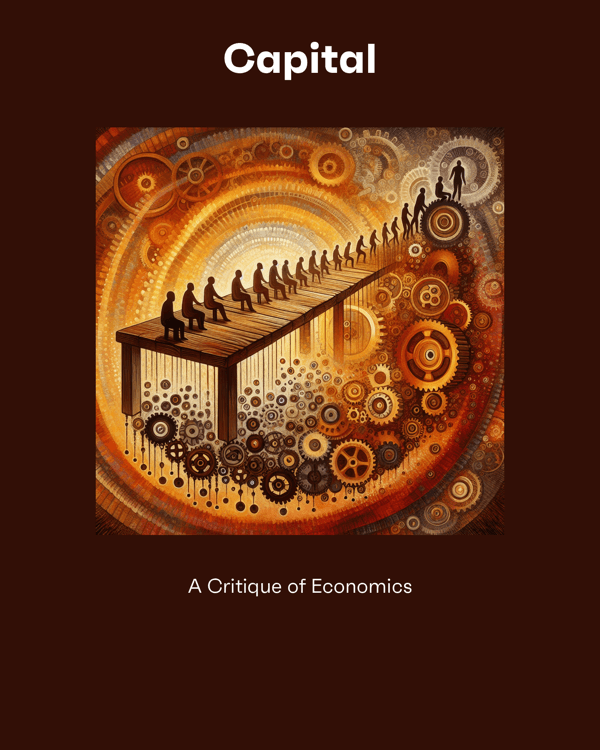
A simple wooden table may seem ordinary, but its transformation into a commodity reveals profound social and economic dynamics. Its value, rooted not in its material or design but in the labor invested, reflects the social nature of work. Commodities like the table embody both tangible utility and intangible social connections, becoming symbols of human effort. This duality extends to money, which, beyond facilitating exchange, represents desires, ambitions, and societal values. Marx highlights how capitalism alienates workers from their labor, products, and each other, reducing work to survival rather than self-expression. This alienation, coupled with the pursuit of surplus value and competition, deepens inequality and fosters systemic crises. Commodities, created through specialized labor, derive their value from the effort they encapsulate, forming the basis of capital. Capital flows through a continuous cycle—money, production, and commodities—sustaining the capitalist system, which relies on interconnected industries to function. This intricate web of labor and resources underscores the complex yet fragile nature of economic structures.

clock10 min
bite5 Bite
target Aperçu

De quoi s'agit-il ?

This book delves into the hidden complexities of everyday objects, exploring how commodities like a simple wooden table transcend their practical use to embody human labor and social relationships. Through the lens of Marxist theory, it examines the dynamics of value creation, labor, and the alienation inherent in capitalist systems. From the relentless pursuit of wealth to the intricate interdependence of industries, it unpacks the economic forces shaping our world. Engaging and thought-provoking, this work invites readers to reconsider the profound social and economic connections behind the seemingly ordinary.

Résumé du livre

German philosopher, economist, and social theorist Karl Marx is regarded as one of the most influential figures in history. His revolutionary ideas about class struggle, capitalism, and economics, which he developed alongside his close collaborator Friedrich Engels, sparked the foundation of many socialist and communist movements across the globe. His published works, including Capital and The Communist Manifesto, continue to influence economic and political debates more than a century and a half after their first appearance.

A simple wooden table may seem ordinary, but its transformation into a commodity reveals profound social and economic dynamics. Its value, rooted not in its material or design but in the labor invested, reflects the social nature of work. Commodities like the table embody both tangible utility and intangible social connections, becoming symbols of human effort. This duality extends to money, which, beyond facilitating exchange, represents desires, ambitions, and societal values. Marx highlights how capitalism alienates workers from their labor, products, and each other, reducing work to survival rather than self-expression. This alienation, coupled with the pursuit of surplus value and competition, deepens inequality and fosters systemic crises. Commodities, created through specialized labor, derive their value from the effort they encapsulate, forming the basis of capital. Capital flows through a continuous cycle—money, production, and commodities—sustaining the capitalist system, which relies on interconnected industries to function. This intricate web of labor and resources underscores the complex yet fragile nature of economic structures.

Pour lire le reste du livre, téléchargez Bitely

appstoregoogleplayapp gallery
Toutes les bouchées
bite5 Bites

Decoding Labor and Value in Commodities

1
logo

Unveiling the Hidden Value of Labor

2
logo

Circuits of Capital: The Lifeblood of Production

3
logo

The Endless Pursuit of Wealth and Value

4
logo

Labor, Value, and the Alienation Cycle

5
logo

Livres associés

mailbox-icon

Voulez-vous continuer à apprendre ?

Ne manquez pas les mises à jour de l'univers passionnant de Bitely !