Résumé du livre
Laura Tunbridge is a scholar of German Romanticism and nineteenth-century music. She has written three monographs, including one on German composer Robert Schumann, and is currently a Professor of Music and a Henfrey Fellow at St. Catherine’s College, University of Oxford.
By 1818, Beethoven’s reputation had soared, marked by his receipt of a Broadwood piano, which transformed his compositions with its enhanced range and depth. This innovation enabled groundbreaking works like the Hammerklavier Sonata, though its complexity exceeded the capabilities of most pianos of the time. Earlier, in 1814, Beethoven reached a career high as Vienna celebrated Napoleon’s defeat. His patriotic piece, “Wellington’s Victory,” gained immense popularity, allowing him the freedom to debut his opera *Fidelio*, a tale of love and resilience that faced censorship but ultimately succeeded. However, these triumphs gave way to personal struggles, including declining health, strained relationships, and creative torment, as noted by biographer David Wyn Jones. Beethoven’s ambitious compositions often challenged performers and audiences, as seen in his 1808 concert featuring the Choral Fantasy, a precursor to his Ninth Symphony. His innovative spirit also shone in works like the Septet, op. 20, which resonated with contemporary tastes and secured his first major success. Despite his reserved demeanor, partly attributed to his hearing loss, Beethoven maintained a vibrant social presence and left a legacy of emotionally profound works, including the enigmatic “Immortal Beloved” letter and the revolutionary "Eroica" Symphony, which reflected his disillusionment with Napoleon. These moments underscore Beethoven’s enduring impact as a visionary who reshaped music against the backdrop of personal and historical upheaval.
Pour lire le reste du livre, téléchargez
Bitely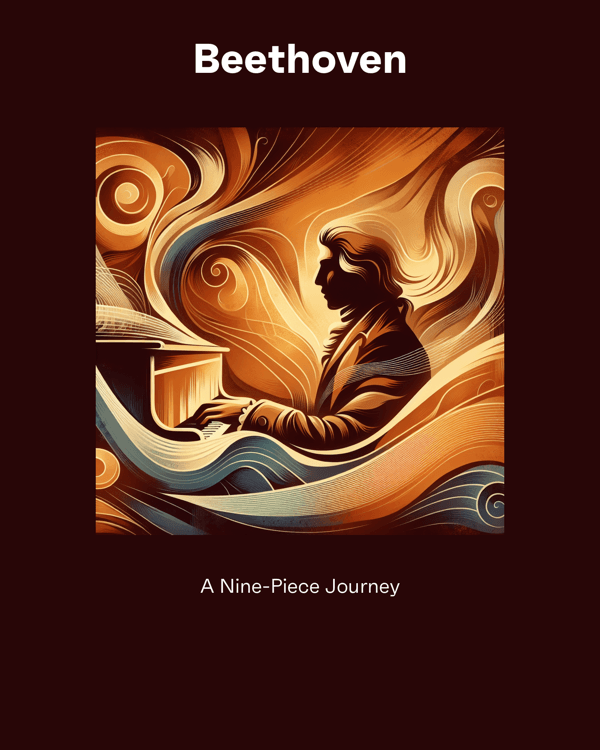

 17 min
 10 Bite
 Aperçu


 10 Bites