Nature & Science
An Immense WorldAn Immense World

An Immense World

user-icon

Ed Yong

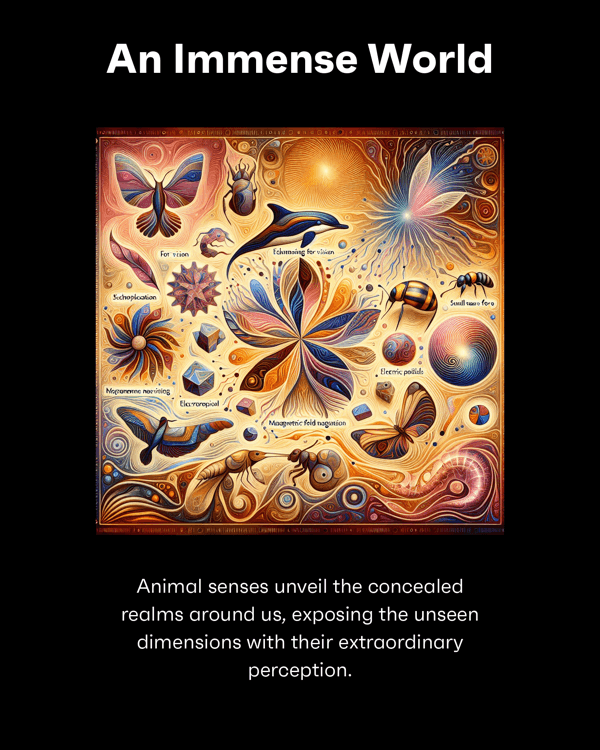
Human senses shape much of our interaction with the world, but the animal kingdom reveals an astonishing variety of sensory adaptations. While humans rely heavily on vision, with trichromatic color perception, animals like dogs and horses see fewer colors due to having only two cones, and creatures with more cones perceive colors beyond human comprehension, though differently. Echolocation, used by bats and dolphins, allows navigation through sound, a skill humans like Daniel Kish can develop, albeit with less precision. Smell plays a critical role for ants, who use pheromones for communication, while humans experience smell and taste as intertwined senses, influencing flavor perception. Other animals excel in detecting forces humans cannot sense, such as melanophila beetles perceiving infrared radiation from miles away, or birds, sea turtles, and lobsters navigating via Earth’s magnetic field. Electroreception aids fish like electric eels and sharks in hunting, while touch is paramount for star-nosed moles, whose sensitive noses identify and consume food in milliseconds, and crocodilians, whose receptors detect prey and aid in feeding. Even vibrations serve as communication for insects like treehoppers, whose rhythmic signals convey messages imperceptible to humans. These sensory adaptations highlight the incredible diversity in how life perceives and interacts with the environment.

clock5 min
bite4 Bite
target Aperçu

De quoi s'agit-il ?

Human senses shape how we perceive and interact with the world, but the animal kingdom reveals a stunning variety of sensory adaptations beyond our own. This book explores the extraordinary ways creatures experience their environments, from the color perception of trichromats and echolocation in bats to the pheromone-based communication of ants and the tactile precision of star-nosed moles. Through vivid examples, it delves into the unique sensory worlds of animals, offering a fascinating glimpse into the diverse ways life has evolved to navigate and survive.

Résumé du livre

Ed Yong is a renowned science writer and public speaker whose work has appeared in the pages of the Atlantic, Nature, Scientific American, the New York Times, Wired, and many more. He also edits a blog on the National Geographic website entitled Not Exactly Rocket Science.

Human senses shape much of our interaction with the world, but the animal kingdom reveals an astonishing variety of sensory adaptations. While humans rely heavily on vision, with trichromatic color perception, animals like dogs and horses see fewer colors due to having only two cones, and creatures with more cones perceive colors beyond human comprehension, though differently. Echolocation, used by bats and dolphins, allows navigation through sound, a skill humans like Daniel Kish can develop, albeit with less precision. Smell plays a critical role for ants, who use pheromones for communication, while humans experience smell and taste as intertwined senses, influencing flavor perception. Other animals excel in detecting forces humans cannot sense, such as melanophila beetles perceiving infrared radiation from miles away, or birds, sea turtles, and lobsters navigating via Earth’s magnetic field. Electroreception aids fish like electric eels and sharks in hunting, while touch is paramount for star-nosed moles, whose sensitive noses identify and consume food in milliseconds, and crocodilians, whose receptors detect prey and aid in feeding. Even vibrations serve as communication for insects like treehoppers, whose rhythmic signals convey messages imperceptible to humans. These sensory adaptations highlight the incredible diversity in how life perceives and interacts with the environment.

Pour lire le reste du livre, téléchargez Bitely

appstoregoogleplayapp gallery
Toutes les bouchées
bite4 Bites

Exploring the Extraordinary Ways We Perceive

1
logo

Scent Trails and the Science of Flavor

2
logo

Extraordinary Animal Senses That Redefine Perception

3
logo

Sensing the Unseen: Nature’s Hidden Powers

4
logo

Livres associés

mailbox-icon

Voulez-vous continuer à apprendre ?

Ne manquez pas les mises à jour de l'univers passionnant de Bitely !