Politics & Society
Adults in The RoomAdults in The Room

Adults in The Room

user-icon

Yanis Varoufakis

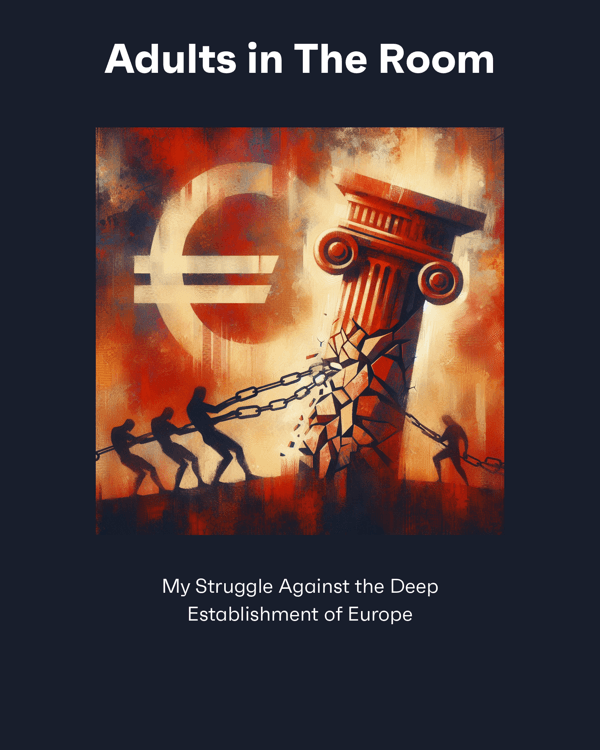
In 2010, Greece became the focus of global attention as it received financial aid from the European Union, but its economic troubles had been brewing long before the 2008 global financial crisis. Decades of tax evasion, government corruption, and reckless overspending had left the nation vulnerable, with its switch to the euro eliminating the option of currency devaluation to manage deficits. Instead, Greece relied heavily on borrowing, particularly from Germany and France, which only deepened its debt. As Greece teetered on the brink of bankruptcy, German and French leaders, fearing the collapse of their own banks that had lent to Greece, misrepresented the crisis to secure taxpayer-funded loans for Greece to repay existing debts. The troika—comprising the European Commission, the European Central Bank, and the International Monetary Fund—stepped in with bailouts tied to harsh austerity measures, further crippling Greece’s economy. By 2015, public frustration led to the election of a new government, with Finance Minister Yanis Varoufakis proposing reforms to alleviate the crisis. However, his efforts were thwarted by both internal political dynamics and the troika’s resistance, culminating in Prime Minister Alexis Tsipras accepting a third bailout despite public opposition. This decision, accompanied by severe austerity policies, entrenched Greece in economic hardship, exposing the troika’s prioritization of control over genuine recovery.

clock13 min
bite7 Bite
target Aperçu

De quoi s'agit-il ?

Greece’s financial crisis, which erupted in 2010, was far more complex than the global banking collapse of 2008. Long-standing issues like tax evasion, government corruption, and reckless overspending had already left the economy vulnerable. The adoption of the euro eliminated Greece’s ability to devalue its currency, forcing the nation into unsustainable borrowing from European powers like Germany and France. As the crisis deepened, the European Union, led by the troika, imposed severe austerity measures under the guise of bailouts, further destabilizing Greece and igniting widespread resentment across Europe. This gripping narrative explores the political maneuvering, economic mismanagement, and human cost behind one of modern Europe’s most contentious financial sagas.

Résumé du livre

Yanis Varoufakis is an economist and the former Minister of Finance of Greece. A celebrated academic, he’s lectured at universities around the world, including the University of Texas at Austin and the University of Sydney. His other books include And the Weak Suffer What They Must?: Europe, Austerity and the Threat to Global Stability.

In 2010, Greece became the focus of global attention as it received financial aid from the European Union, but its economic troubles had been brewing long before the 2008 global financial crisis. Decades of tax evasion, government corruption, and reckless overspending had left the nation vulnerable, with its switch to the euro eliminating the option of currency devaluation to manage deficits. Instead, Greece relied heavily on borrowing, particularly from Germany and France, which only deepened its debt. As Greece teetered on the brink of bankruptcy, German and French leaders, fearing the collapse of their own banks that had lent to Greece, misrepresented the crisis to secure taxpayer-funded loans for Greece to repay existing debts. The troika—comprising the European Commission, the European Central Bank, and the International Monetary Fund—stepped in with bailouts tied to harsh austerity measures, further crippling Greece’s economy. By 2015, public frustration led to the election of a new government, with Finance Minister Yanis Varoufakis proposing reforms to alleviate the crisis. However, his efforts were thwarted by both internal political dynamics and the troika’s resistance, culminating in Prime Minister Alexis Tsipras accepting a third bailout despite public opposition. This decision, accompanied by severe austerity policies, entrenched Greece in economic hardship, exposing the troika’s prioritization of control over genuine recovery.

Pour lire le reste du livre, téléchargez Bitely

appstoregoogleplayapp gallery
Toutes les bouchées
bite7 Bites

Greece's Debt Spiral: A Crisis Engineered

1
logo

Greece's Debt Crisis: Power, Austerity, and Betrayal

2
logo

Greece’s Fight Against Debt and Austerity

3
logo

Debt, Power, and Greece's Economic Struggle

4
logo

Betrayal, Austerity, and Greece's Economic Struggle

5
logo

Betrayed Democracy: Greece's Struggle with EU Power

6
logo

Populism's Rise: Europe’s Crisis of Trust

7
logo

Livres associés

mailbox-icon

Voulez-vous continuer à apprendre ?

Ne manquez pas les mises à jour de l'univers passionnant de Bitely !