Résumé du livre
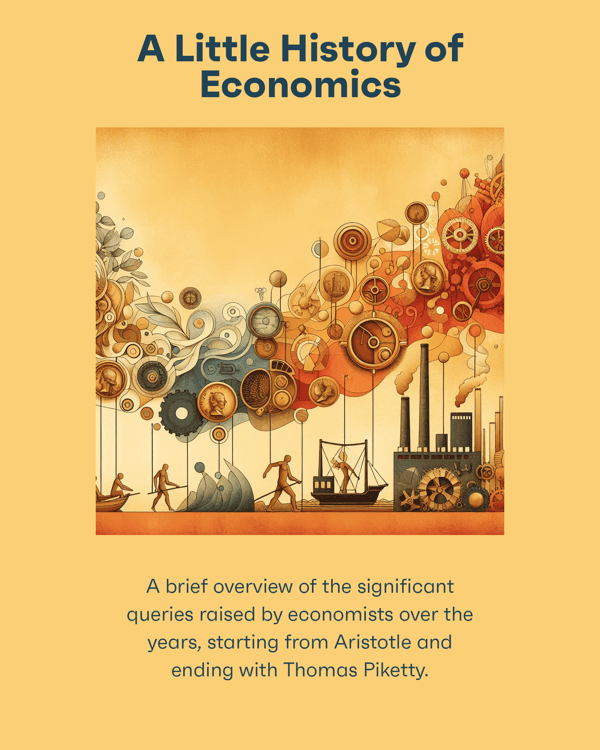
Niall Kishtainy is a professor at the London School of Economics and the University of Warwick. He believes a study of the history of economics can explain a lot about our modern times, and help us move forward in a better way.
Aristotle, often considered the first economist, explored the dual nature of money as a measure of value and a facilitator of trade, while warning against its corrupting influence, such as prioritizing profit over moral obligations. His critiques of practices like usury resonated with later Christian thinkers like St. Thomas Aquinas, though commerce and moneylending became essential as trade expanded. The evolution of banking and the shift to a monetary economy reflected changing attitudes, with even the Catholic Church softening its stance on usury. European exploration and mercantilism further transformed economies, aligning merchants with rulers to amass wealth. By the Industrial Age, economists like Adam Smith and David Ricardo introduced groundbreaking ideas, from the benefits of self-interest and specialization to free trade as a remedy for inequality. However, industrialization also deepened economic disparities, inspiring critiques from early socialists and Karl Marx, who highlighted capitalism’s exploitative nature. Governments began addressing worker exploitation through reforms like education and labor laws, while debates over the role of government in the economy intensified. Keynesian economics gained prominence in the mid-twentieth century, advocating for government intervention during crises, though critics like Milton Friedman later championed market-driven solutions. Meanwhile, global inequality persisted, with economists like Amartya Sen emphasizing the importance of enhancing human capabilities over mere economic growth. Despite proposals to address wealth concentration, such as higher taxes on the rich, governments have largely resisted redistribution, leaving the future of economic equality reliant on innovative approaches.
Pour lire le reste du livre, téléchargez
Bitely







 20 min
 9 Bite
 Aperçu
 9 Bites