Politics & Society
Every Nation For ItselfEvery Nation For Itself

Every Nation For Itself

user-icon

Ian Bremmer

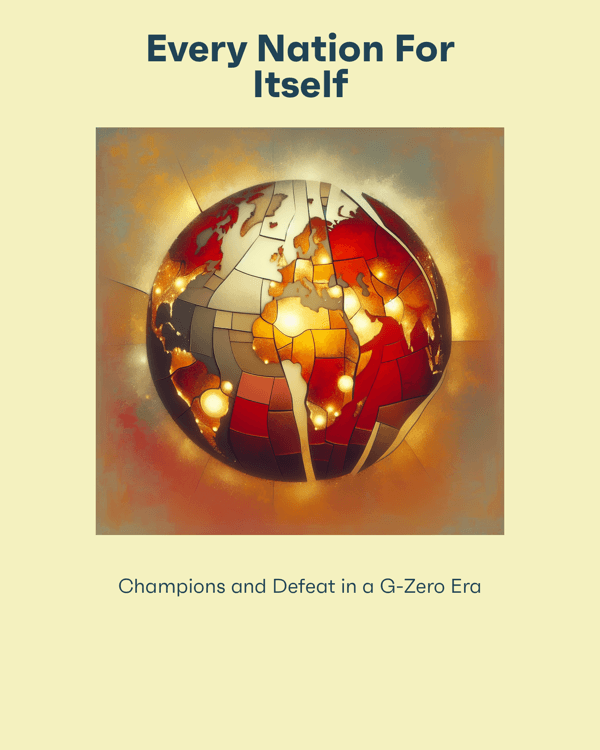
If China and the United States fail to cooperate, the world could face two divergent outcomes. In one scenario, weaker nations are left to choose sides, echoing a Cold War-like division, but this time between the US and China. Their economic interdependence, however, makes direct conflict far more damaging than during the US-USSR rivalry. In the other scenario, stronger nations maintain their independence, resulting in a fragmented world where regional powers like Brazil and Germany take the lead in addressing global issues, albeit within limited spheres of influence. Success in this G-Zero era depends on a nation’s ability to thrive independently, as seen with Brazil and Turkey, while countries overly reliant on traditional alliances, such as Japan and Mexico, may struggle. Yet, the absence of global leadership exacerbates challenges like climate change and food insecurity, with protectionist policies and domestic priorities undermining international cooperation. This leaderless state, while temporary, underscores the urgent need for a new global framework, which will likely hinge on the eventual collaboration—or continued rivalry—between the US and China.

clock10 min
bite5 Bite
target Perspectiva

¿De qué trata?

In a world grappling with shared challenges, this book delves into the critical dynamics between global powers, particularly the United States and China, and the consequences of their cooperation or discord. It explores scenarios ranging from fragmented leadership to potential alliances, examining how nations adapt—or fail to adapt—in a leaderless, interconnected era. Through vivid examples and in-depth analysis, the narrative unpacks the economic, political, and environmental stakes of a G-Zero world, offering a thought-provoking look at the forces shaping our global future.

Resumen del libro

Ian Bremmer is a political risk consultant and the president of the Eurasia Group, the world’s top global political risk consulting and research company. His other publications include The End of the Free Market and The J Curve.

If China and the United States fail to cooperate, the world could face two divergent outcomes. In one scenario, weaker nations are left to choose sides, echoing a Cold War-like division, but this time between the US and China. Their economic interdependence, however, makes direct conflict far more damaging than during the US-USSR rivalry. In the other scenario, stronger nations maintain their independence, resulting in a fragmented world where regional powers like Brazil and Germany take the lead in addressing global issues, albeit within limited spheres of influence. Success in this G-Zero era depends on a nation’s ability to thrive independently, as seen with Brazil and Turkey, while countries overly reliant on traditional alliances, such as Japan and Mexico, may struggle. Yet, the absence of global leadership exacerbates challenges like climate change and food insecurity, with protectionist policies and domestic priorities undermining international cooperation. This leaderless state, while temporary, underscores the urgent need for a new global framework, which will likely hinge on the eventual collaboration—or continued rivalry—between the US and China.

Para leer el resto del libro puedes descargar Bitely

appstoregoogleplayapp gallery
Todos los bocados
bite5 Bites

Navigating a Leaderless World: Global Challenges Unbound

1
logo

Global Challenges in a Divided World

2
logo

Thriving in a Fragmented, Leaderless World

3
logo

Navigating a World Shaped by U.S.-China Dynamics

4
logo

When Superpowers Clash: A World Divided

5
logo

Libros relacionados

mailbox-icon

¿Quieres seguir aprendiendo?

¡No te pierdas las actualizaciones del emocionante universo de Bitely!