Psychology
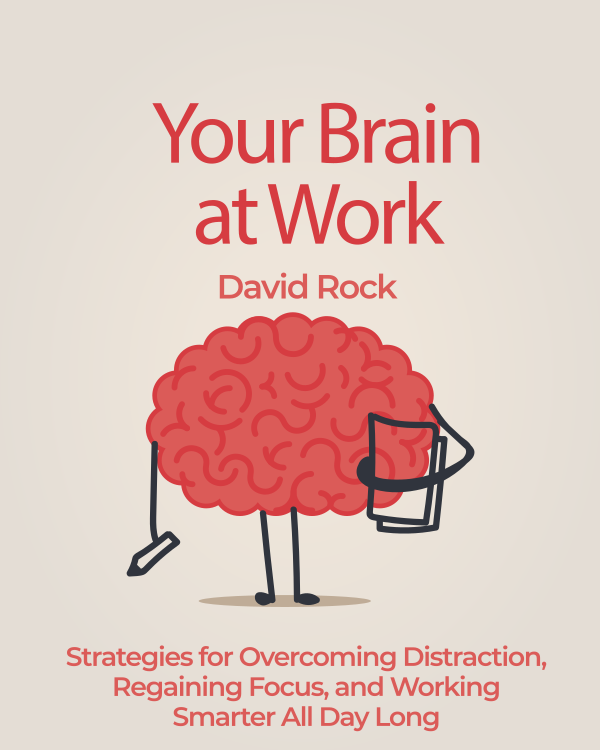
Your Brain at WorkYour Brain at Work
Your Brain at Work

Your Brain at Work

user-icon

David Rock

Often, we believe that increased effort alone will improve performance when we are not delivering our best work. In reality, our brain often requires more energy and rewards for it to keep functioning. This is because the brain easily gets fatigued and distracted, as well as being strongly motivated by factors such as certainty, control, and status. To optimize brain function, it is beneficial to minimize daily distractions, seek opportunities for increased choice and autonomy, and prioritize the development of reflective thinking skills. Distractions should be identified and eliminated. To remain focused, you must recognize and dismiss everyday distractions. For example, remember to switch off your mobile phone and close your email program when working on something that requires active thinking. As a result, your brain will not have to expend energy on pondering unread emails or missed calls. Further, if people discover that you only respond to important emails at a certain time, they will probably send you only those. Expect less. To cultivate a positive mindset, it can be helpful to lower expectations a bit. When you find yourself becoming overly excited about the possibility of achieving a promotion or receiving a reward, consciously resist the urge to become too carried away. By doing so, if you do end up being rewarded, it will be a delightful surprise, and if things don't go as planned, it won't be as disappointing.

hashtagself-help
hashtagproductivity
hashtagneuroscience
hashtagbusiness
hashtagbrain
clock18 min
bite10 Bite
target Einblick

Worum geht es?

Your Brain at Work offers various ways to improve our thinking skills while also investigating how the brain works. It provides a variety of techniques that will aid us in overcoming distraction and improving our focus, drawing on many neuropsychological studies carried out over the past 25 years.

Buchzusammenfassung

David Rock, who coined the term neuroleadership, is co-founder and CEO of the NeuroLeadership Institute (NLI). He has written four books on business and contributed numerous articles on leadership, organizational effectiveness, and neuroscience to leading publications including Harvard Business Review, The New York Times, The Wall Street Journal, Business Insider, and the BBC. Originally from Australia, Dr. Rock has resided in the United States since 2010.

Often, we believe that increased effort alone will improve performance when we are not delivering our best work. In reality, our brain often requires more energy and rewards for it to keep functioning. This is because the brain easily gets fatigued and distracted, as well as being strongly motivated by factors such as certainty, control, and status. To optimize brain function, it is beneficial to minimize daily distractions, seek opportunities for increased choice and autonomy, and prioritize the development of reflective thinking skills. Distractions should be identified and eliminated. To remain focused, you must recognize and dismiss everyday distractions. For example, remember to switch off your mobile phone and close your email program when working on something that requires active thinking. As a result, your brain will not have to expend energy on pondering unread emails or missed calls. Further, if people discover that you only respond to important emails at a certain time, they will probably send you only those. Expect less. To cultivate a positive mindset, it can be helpful to lower expectations a bit. When you find yourself becoming overly excited about the possibility of achieving a promotion or receiving a reward, consciously resist the urge to become too carried away. By doing so, if you do end up being rewarded, it will be a delightful surprise, and if things don't go as planned, it won't be as disappointing.

“Mindfulness is a habit, it’s something the more one does, the more likely one is to be in that mode with less and less effort."

“Sometimes reducing a problem to one short sentence can be enough to bring about insight on its own.”

“The right dose of expectations can be as powerful as one of the strongest painkillers.”

Um den Rest des Buches zu lesen, können Sie Bitely herunterladen

appstoregoogleplayapp gallery
Alle Bissen
bite10 Bites

Preserve your thinking capacity as much as possible, as it is limited.

1
logo

Although we get distracted easily, there are ways to stay focused.

2
logo

To perform optimally, your brain must be stimulated properly.

3
logo

You can overcome mental limitations by having insights.

4
logo

The brain's structure changes when you practice mindfulness.

5
logo

The brain finds certainty and control incredibly satisfying, and you may cultivate these emotions on your own.

6
logo

It's essential to regulate your expectations to feel happy in general.

7
logo

The brain perceives a sense of connection with others and getting treated right as fundamental rewards.

8
logo

We can manipulate our brains into feeling rewarded for status increases.

9
logo

Feedback rarely affects others positively; instead, help them reach their own conclusions.

10
logo

Verwandte Bücher

mailbox-icon

Möchten Sie weiter lernen?

Verpassen Sie keine Updates aus dem aufregenden Universum von Bitely!