Buchzusammenfassung
Jeremy Rifkin is one of the most popular thought leaders of our time. In addition to advising leading companies, heads of state and even the European Union, he is the bestselling author of no less than 20 books, including The End of Work and The Empathic Civilization.
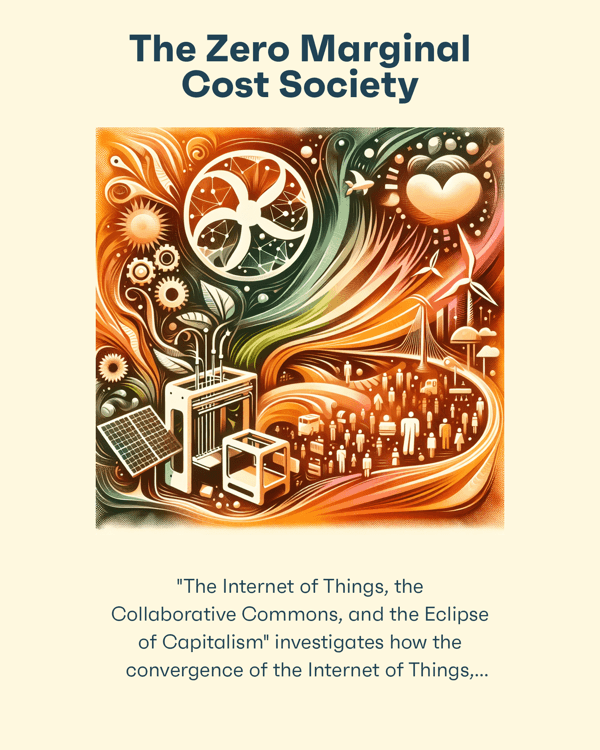
Since the Second Industrial Revolution, mass production has dominated manufacturing, but advancements like 3D printing are democratizing the process, enabling individuals to produce goods more efficiently and sustainably. Similarly, green energy technologies are shifting power from large corporations to prosumers, supported by smart grids that integrate energy and communication systems. However, capitalism's reliance on infinite growth clashes with finite resources, as automation and technological efficiencies reduce costs but also displace workers, threatening economic stability. The internet has further disrupted traditional systems, fostering a new economy where individuals, as prosumers, prioritize access and sharing over ownership. Meanwhile, inefficiencies in logistics and transportation highlight the need for collaborative solutions, such as shared networks to reduce waste. Education, too, is evolving, with a shift toward collaborative, interdisciplinary learning that mirrors the principles of a decentralized, resource-efficient society. Together, these changes signal a profound transformation in how we produce, consume, and share resources.
Um den Rest des Buches zu lesen, können Sie
Bitely herunterladen

 13 min
 8 Bite
 Einblick


 8 Bites