Nature & Science
The Upright ThinkersThe Upright Thinkers

The Upright Thinkers

user-icon

Leonard Mlodinow

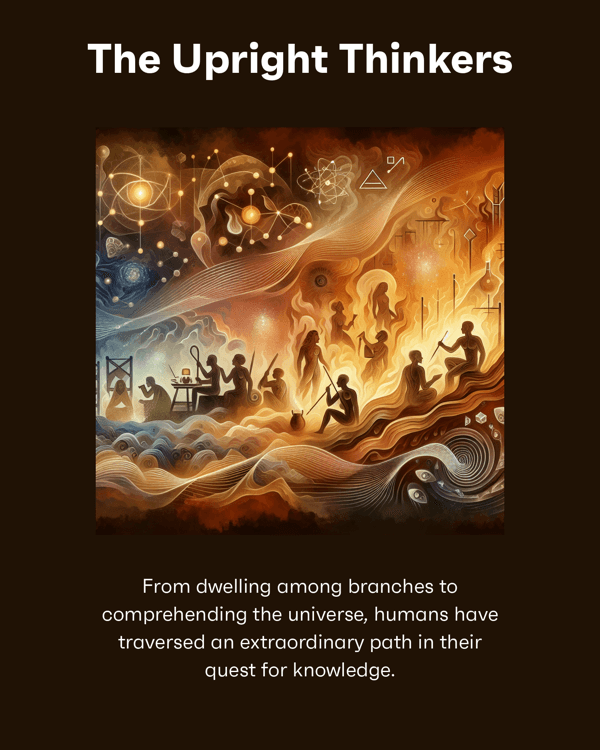
The evolution of scientific thought, much like the construction of Rome, was a gradual process shaped by humanity’s innate curiosity and creativity. Early humans relied on problem-solving skills to innovate tools and harness fire, setting the stage for survival and advancement. This inquisitiveness distinguished humans from other species and flourished as communities formed, such as those in ancient Turkey 11,500 years ago, where knowledge exchange and collaboration spurred innovations like irrigation systems. The division of labor in Mesopotamia around 7000 BCE further advanced society, leading to specialized professions and the establishment of schools. Ancient Greek philosophers like Thales, Pythagoras, and Aristotle revolutionized thinking by seeking logical explanations for natural phenomena, laying the groundwork for modern science. Centuries later, figures like Galileo and Newton refined scientific methods through meticulous experimentation, while Darwin’s theory of evolution transformed biology. The discovery of atoms and quantum theory by pioneers like Planck, Einstein, Heisenberg, and Schrödinger unlocked the mysteries of the unseen world, enabling technological advancements that shape modern life. This journey of knowledge, from early writing in Mesopotamia to the development of mathematics and literacy, underscores humanity’s relentless pursuit of understanding and innovation.

clock15 min
bite9 Bite
target Einblick

Worum geht es?

The evolution of scientific thinking, much like the construction of Rome, was a gradual process spanning centuries. This book delves into humanity's innate curiosity and creativity, tracing how these traits shaped our survival, innovation, and understanding of the natural world. From the collaborative problem-solving of ancient communities to groundbreaking discoveries in physics, biology, and chemistry, it explores the milestones that transformed knowledge into modern science. Through vivid stories of pioneering thinkers and their relentless pursuit of answers, the narrative reveals how curiosity and collaboration have continually driven progress.

Buchzusammenfassung

Leonard Mlodinow was an American theoretical physicist, mathematician, screenwriter and author, best known for his contributions to physics, particularly in the large N expansion, a technique for approximating the spectra of atoms by considering an infinite-dimensional version of the problem. Beyond his scientific work, he has also written books for a general readership.

The evolution of scientific thought, much like the construction of Rome, was a gradual process shaped by humanity’s innate curiosity and creativity. Early humans relied on problem-solving skills to innovate tools and harness fire, setting the stage for survival and advancement. This inquisitiveness distinguished humans from other species and flourished as communities formed, such as those in ancient Turkey 11,500 years ago, where knowledge exchange and collaboration spurred innovations like irrigation systems. The division of labor in Mesopotamia around 7000 BCE further advanced society, leading to specialized professions and the establishment of schools. Ancient Greek philosophers like Thales, Pythagoras, and Aristotle revolutionized thinking by seeking logical explanations for natural phenomena, laying the groundwork for modern science. Centuries later, figures like Galileo and Newton refined scientific methods through meticulous experimentation, while Darwin’s theory of evolution transformed biology. The discovery of atoms and quantum theory by pioneers like Planck, Einstein, Heisenberg, and Schrödinger unlocked the mysteries of the unseen world, enabling technological advancements that shape modern life. This journey of knowledge, from early writing in Mesopotamia to the development of mathematics and literacy, underscores humanity’s relentless pursuit of understanding and innovation.

“The first step in battling the illusion of control is to be aware of if. But even then it is difficult, once we think we see a pattern, we do not easily let go of our perception.”

“We all understand that genius doesn’t guarantee success, but it’s seductive to assume that success must come from genius.”

“Successful people in every field are almost universally members of a certain set—the set of people who don’t give up.”

Um den Rest des Buches zu lesen, können Sie Bitely herunterladen

appstoregoogleplayapp gallery
Alle Bissen
bite9 Bites

Curiosity Unleashed: The Evolution of Human Innovation

1
logo

From Symbols to Science: Humanity's Knowledge Revolution

2
logo

Ancient Curiosity That Shaped Modern Science

3
logo

Pioneers of Discovery: The Bold Path to Modern Science

4
logo

Transforming Matter: The Evolution of Chemistry

5
logo

Unveiling Life’s Secrets Through Scientific Discovery

6
logo

Unlocking the Atomic Universe: Pioneers of Quantum Discovery

7
logo

Unveiling the Hidden Forces Shaping Atoms

8
logo

Harnessing the Unseen: Quantum Science's Journey

9
logo

Verwandte Bücher

mailbox-icon

Möchten Sie weiter lernen?

Verpassen Sie keine Updates aus dem aufregenden Universum von Bitely!