Buchzusammenfassung
Fritjof Capra holds a PhD in theoretical physics from the University of Vienna. He is a prolific author and lecturer on the philosophical aspects of modern science. Capra’s other books include The Turning Point, Uncommon Wisdom and The Web of Life.
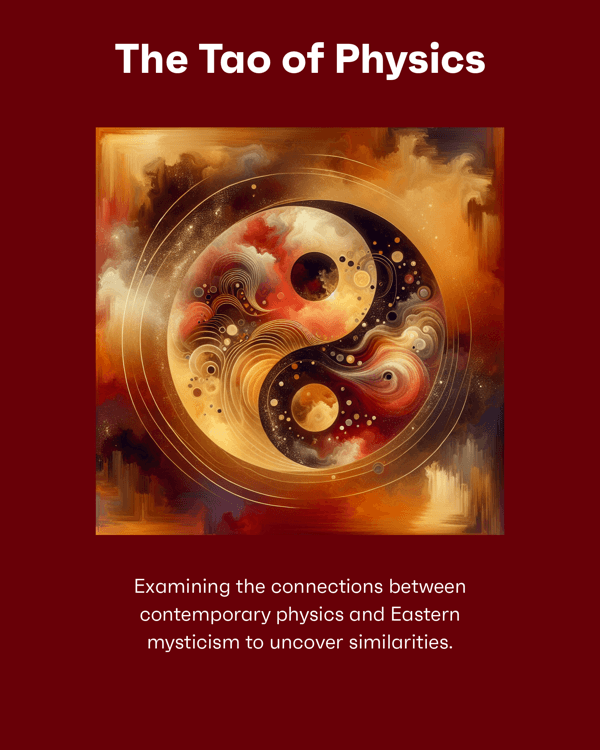
Ancient Chinese philosophy is rooted in two dimensions: practicality, focusing on ethics and governance, and mysticism, seeking higher consciousness. By the sixth century B.C., these evolved into Confucianism, emphasizing social order, and Taoism, which explores nature’s harmony and a mystical ultimate reality called the Tao. This reality, a dynamic cosmic process, is shaped by the interplay of yin and yang, reflecting Taoism’s cyclical worldview. Similar to Hinduism and Buddhism, Taoism values intuitive wisdom over rationality, creating a bridge to modern physics. Though physics relies on mathematical precision and mysticism on meditation, both blend rational and intuitive knowledge. Western thought separates mind and body, while Eastern philosophy emphasizes interconnectedness. Hinduism and Buddhism share this view, with Hinduism focusing on Brahman, the ultimate reality, and Buddhism on nirvana, where separateness dissolves. Both traditions highlight impermanence and unity, themes mirrored in modern physics. Einstein’s relativity and quantum theory challenge classical physics, revealing the interconnectedness of matter, space, and observation. These parallels between physics and Eastern mysticism—such as the duality of particles and waves or the unity of space-time—underscore a shared pursuit of understanding reality’s fundamental nature. This exploration sets the stage for deeper discussions of Eastern mystical traditions.
Um den Rest des Buches zu lesen, können Sie
Bitely herunterladen








 12 min
 8 Bite
 Einblick
 8 Bites