
Economy & Finance
The Managerial RevolutionThe Managerial Revolution

The Managerial Revolution

user-icon

James Burnham

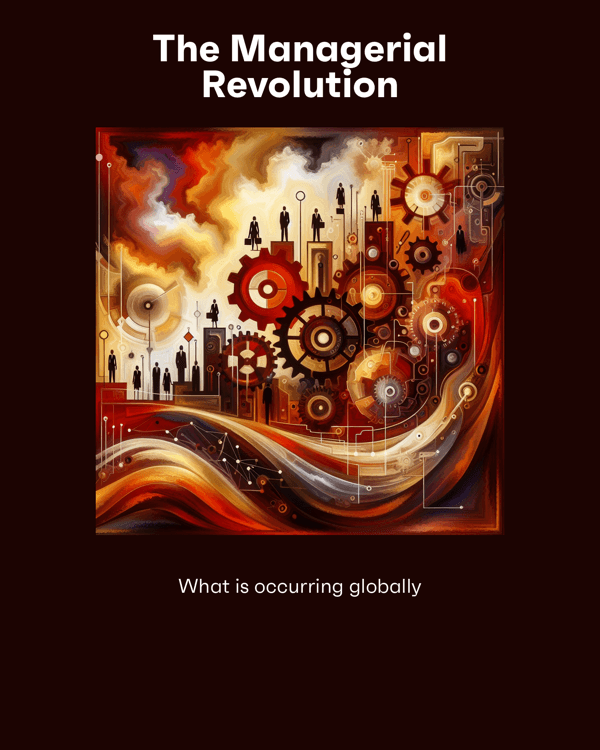
As society appeared to transition from capitalism to a managerial framework, the author examined capitalism’s defining traits: the commodification of all goods and labor, the dual role of money as both exchange medium and capital, the profit-driven nature of production, and the division of society into capitalists and workers. By the early 20th century, governments began assuming control over key industries, diminishing capitalist influence and expanding bureaucratic power. This shift saw managers—whether in private corporations or government agencies—emerge as the new ruling class, consolidating authority over production. The author speculated that if communism failed to replace capitalism, a managerial society would dominate, with state ownership of production and managers as the de facto elite. While communism’s appeal as a classless ideal faltered due to its failures in Russia, capitalism’s decline signaled an uncertain societal transformation, with the rise of managers reshaping power structures.

clock8 min
bite6 Bite
target Einblick

Worum geht es?

The book explores a pivotal moment in history when society appeared to be transitioning from capitalism to a new managerial era. Through a detailed examination of capitalism’s defining traits—such as commodification, profit-driven production, and class divisions—it delves into the rise of a managerial class that began to eclipse traditional capitalists. The narrative also considers the growing influence of bureaucrats within government systems, envisioning a future where managers, not capitalists or communists, dominate global power structures. This thought-provoking work challenges assumptions about societal evolution, offering a rich analysis of economic and political shifts that continue to resonate today.

Buchzusammenfassung

James Burnham was an American political theorist and philosopher. In later life, he was a prominent public intellectual who regularly contributed to publications such as the National Review.

As society appeared to transition from capitalism to a managerial framework, the author examined capitalism’s defining traits: the commodification of all goods and labor, the dual role of money as both exchange medium and capital, the profit-driven nature of production, and the division of society into capitalists and workers. By the early 20th century, governments began assuming control over key industries, diminishing capitalist influence and expanding bureaucratic power. This shift saw managers—whether in private corporations or government agencies—emerge as the new ruling class, consolidating authority over production. The author speculated that if communism failed to replace capitalism, a managerial society would dominate, with state ownership of production and managers as the de facto elite. While communism’s appeal as a classless ideal faltered due to its failures in Russia, capitalism’s decline signaled an uncertain societal transformation, with the rise of managers reshaping power structures.

Um den Rest des Buches zu lesen, können Sie Bitely herunterladen
appstoregoogleplayapp gallery
Alle Bissen
bite6 Bites

Rise of the Managerial Class: A New Era

1
logo

Capitalism’s Decline and the Uncertain Future

2
logo

Capitalism’s Decline and the Rise of Managers

3
logo

Rise of the Managerial Ruling Class

4
logo

Rise of the Managerial Ruling Class

5
logo

Managers Ascend: The New Ruling Elite

6
logo

Verwandte Bücher

mailbox-icon

Möchten Sie weiter lernen?

Verpassen Sie keine Updates aus dem aufregenden Universum von Bitely!