Psychology
The Invisible GorillaThe Invisible Gorilla

The Invisible Gorilla

user-icon

Christopher Chabris and Daniel Simons

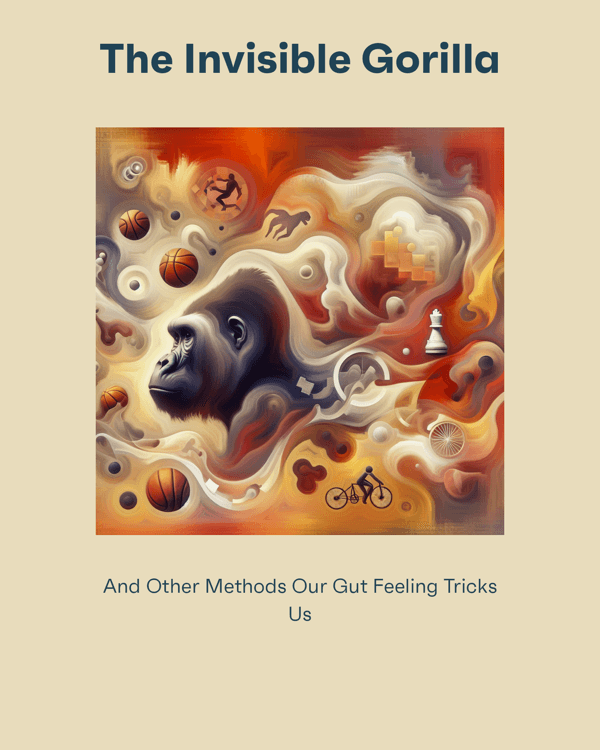
Our attention often blinds us to the obvious, as seen in the Invisible Gorilla experiment, where participants focused on counting basketball passes missed a man in a gorilla suit. This selective focus can have serious consequences, such as drivers overlooking motorcycles while watching for cars. Similarly, intuition, though celebrated, can mislead us, as demonstrated by art experts misjudging forgeries or overconfident chess players overestimating their abilities. Memory, too, is unreliable, often altered or fabricated, leading us to trust inaccurate recollections. Overconfidence in our knowledge is another pitfall, exemplified by participants failing to accurately draw a bicycle despite claiming to understand its mechanics. Even with more information, as in investment studies, we often make poorer decisions, proving that more data doesn’t guarantee better comprehension. Finally, our tendency to see patterns where none exist, like linking weather to arthritis pain or drowning rates to ice cream sales, highlights how easily we mistake coincidence for causation.

clock9 min
bite6 Bite
target Einblick

Worum geht es?

Our perceptions are often shaped by focus, intuition, memory, and overconfidence, yet these very tools can mislead us in surprising ways. This book delves into fascinating experiments and real-world examples, revealing how our minds overlook the obvious, misjudge abilities, and create false connections. From the Invisible Gorilla experiment to the pitfalls of overanalyzing investments, it uncovers the quirks of human cognition and decision-making. Engaging and thought-provoking, it challenges readers to question what they think they know and why they believe it.

Buchzusammenfassung

Christopher Chabris is associate professor of psychology and co-director of the neuroscience program at Union College in Schenectady, New York. He is also a chess master who writes about the game for the Wall Street Journal.

Our attention often blinds us to the obvious, as seen in the Invisible Gorilla experiment, where participants focused on counting basketball passes missed a man in a gorilla suit. This selective focus can have serious consequences, such as drivers overlooking motorcycles while watching for cars. Similarly, intuition, though celebrated, can mislead us, as demonstrated by art experts misjudging forgeries or overconfident chess players overestimating their abilities. Memory, too, is unreliable, often altered or fabricated, leading us to trust inaccurate recollections. Overconfidence in our knowledge is another pitfall, exemplified by participants failing to accurately draw a bicycle despite claiming to understand its mechanics. Even with more information, as in investment studies, we often make poorer decisions, proving that more data doesn’t guarantee better comprehension. Finally, our tendency to see patterns where none exist, like linking weather to arthritis pain or drowning rates to ice cream sales, highlights how easily we mistake coincidence for causation.

Um den Rest des Buches zu lesen, können Sie Bitely herunterladen
appstoregoogleplayapp gallery
Alle Bissen
bite6 Bites

When Instincts Deceive: The Limits of Intuition

1
logo

When Focus Fails: The Cost of Overlooking

2
logo

When Memories Lie: The Illusion of Accuracy

3
logo

The Illusion of Confidence and Competence

4
logo

Overconfidence: Why Familiarity Breeds Misunderstanding

5
logo

Chasing Patterns: Why We See Connections That Aren’t There

6
logo

Verwandte Bücher

mailbox-icon

Möchten Sie weiter lernen?

Verpassen Sie keine Updates aus dem aufregenden Universum von Bitely!