Buchzusammenfassung
Dee Denver is a professor of evolutionary genetics at Oregon State University who specializes in the study of DNA mutation and the evolution of genomes. He’s currently working on a multidisciplinary project exploring what Buddhists and biologists can learn from each other.
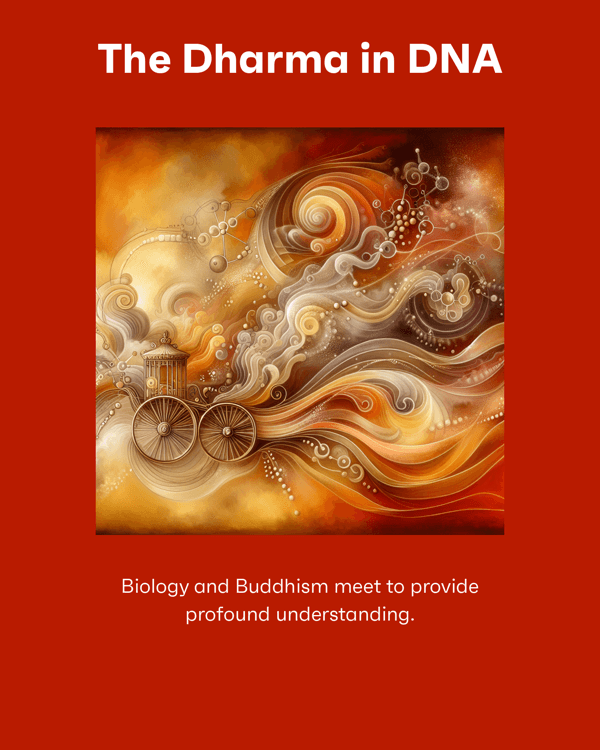
Buddhists reject the idea of a permanent self, instead viewing existence as an ongoing process of interaction and change—a perspective that challenges Western traditions rooted in centuries of religious, philosophical, and scientific thought. Interestingly, modern science echoes this view, with theories like Francis Crick’s suggesting that identity is merely a complex assembly of cells and molecules, shaped by the interplay of genetics and environment. This dynamic understanding of self aligns with Buddhist teachings, such as the concept of anatman, or nonself, illustrated in the story of Nagasena and King Menander. Nagasena explained that identity, like a chariot, cannot be reduced to any single part but is instead a composite of impermanent elements. Similarly, the Buddha described personhood as a combination of five ever-changing components, emphasizing that embracing impermanence is key to reducing suffering. This notion of transformation resonates beyond Buddhism, as seen in the broader narrative of societal progress—from the empirical inquiries of the ancient Greeks to the scientific breakthroughs of Darwin—where the tension between faith and reason continues to evolve, now enriched by perspectives like Buddhist philosophy.
Um den Rest des Buches zu lesen, können Sie
Bitely herunterladen








 4 min
4 min 3 Bite
 Einblick
 3 Bites