Biography & History
Songs of AmericaSongs of America

Songs of America

user-icon

Jon Meacham and Tim McGraw

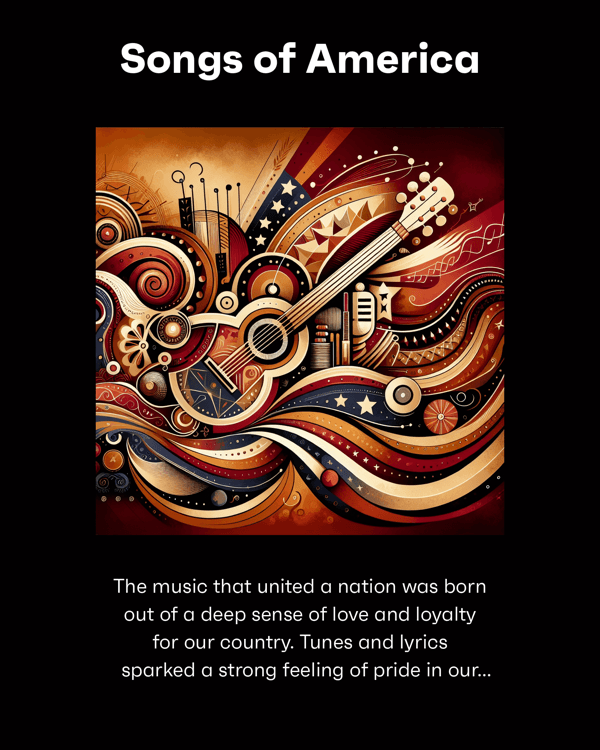
The United States has long grappled with the interplay between music and its social, political, and cultural struggles, as seen across pivotal moments in its history. From Franklin D. Roosevelt’s hopeful 1932 rally anthem "Happy Days Are Here Again" to Woody Guthrie’s critical response with "This Land is Your Land," music has reflected both optimism and dissent. Similarly, Francis Scott Key’s "The Star-Spangled Banner" emerged as a patriotic symbol during the War of 1812, while Native American songs of the 1830s mourned the devastating Trail of Tears. The Vietnam War era showcased music’s polarizing power, with anti-war anthems like Edwin Starr’s "War" clashing against Middle America’s "Okie from Muskogee." Women’s suffrage marches in the early 20th century were energized by songs like "Daughters of Freedom," while African Americans found resilience in "Lift Every Voice and Sing," a poignant reflection of their ongoing fight for equality. The Revolutionary War birthed unifying songs like "The Liberty Song," yet excluded groups like women and African Americans expressed their aspirations through works such as Phillis Wheatley’s poetry and the abolitionist anthem "Farewell Song." During the Civil War, music like "Battle Cry of Freedom" inspired Union soldiers, while spirituals like "Go Down Moses" marked the dawn of emancipation. In the 20th century, figures like Elvis Presley and Bruce Springsteen used music to embody and critique the American Dream, highlighting themes of cultural appropriation, excess, and economic inequality. Through these diverse voices, music has remained a powerful lens for understanding America’s evolving identity.

clock12 min
bite7 Bite
target Einblick

Worum geht es?

This book delves into the profound connection between music and pivotal moments in American history, exploring how songs have both reflected and shaped the nation’s struggles, triumphs, and cultural shifts. From the anthems of revolution and suffrage to the spirituals of emancipation and the protest songs of the Vietnam era, it examines the power of music as a tool for unity, resistance, and expression. Through vivid storytelling, it highlights the voices that have defined America’s evolving identity, offering a rich tapestry of resilience, hope, and critique. This is a compelling journey through the melodies that have accompanied America’s most defining moments.

Buchzusammenfassung

Jon Meacham is an American author. In 2009, he won the Pulitzer Prize for his biographical book American Lion: Andrew Jackson in the White House. He is currently a contributing editor to Time Magazine. Tim McGraw is a country music singer and actor. He has received three Grammys and ten American Music Awards.

The United States has long grappled with the interplay between music and its social, political, and cultural struggles, as seen across pivotal moments in its history. From Franklin D. Roosevelt’s hopeful 1932 rally anthem "Happy Days Are Here Again" to Woody Guthrie’s critical response with "This Land is Your Land," music has reflected both optimism and dissent. Similarly, Francis Scott Key’s "The Star-Spangled Banner" emerged as a patriotic symbol during the War of 1812, while Native American songs of the 1830s mourned the devastating Trail of Tears. The Vietnam War era showcased music’s polarizing power, with anti-war anthems like Edwin Starr’s "War" clashing against Middle America’s "Okie from Muskogee." Women’s suffrage marches in the early 20th century were energized by songs like "Daughters of Freedom," while African Americans found resilience in "Lift Every Voice and Sing," a poignant reflection of their ongoing fight for equality. The Revolutionary War birthed unifying songs like "The Liberty Song," yet excluded groups like women and African Americans expressed their aspirations through works such as Phillis Wheatley’s poetry and the abolitionist anthem "Farewell Song." During the Civil War, music like "Battle Cry of Freedom" inspired Union soldiers, while spirituals like "Go Down Moses" marked the dawn of emancipation. In the 20th century, figures like Elvis Presley and Bruce Springsteen used music to embody and critique the American Dream, highlighting themes of cultural appropriation, excess, and economic inequality. Through these diverse voices, music has remained a powerful lens for understanding America’s evolving identity.

Um den Rest des Buches zu lesen, können Sie Bitely herunterladen
appstoregoogleplayapp gallery
Alle Bissen
bite7 Bites

Songs That Shaped America’s Struggles and Triumphs

1
logo

Songs of Struggle and Symbols of Hope

2
logo

Voices of Freedom: Music's Role in Liberation

3
logo

Voices of Change: Music's Role in Revolution

4
logo

Songs That Shaped America’s Struggles and Hope

5
logo

Voices of Division: Music in Vietnam's Turmoil

6
logo

Elvis to Springsteen: America’s Contradictions in Song

7
logo

Verwandte Bücher

mailbox-icon

Möchten Sie weiter lernen?

Verpassen Sie keine Updates aus dem aufregenden Universum von Bitely!