Nature & Science
Rational RitualRational Ritual

Rational Ritual

user-icon

Michael Suk-Young Chwe

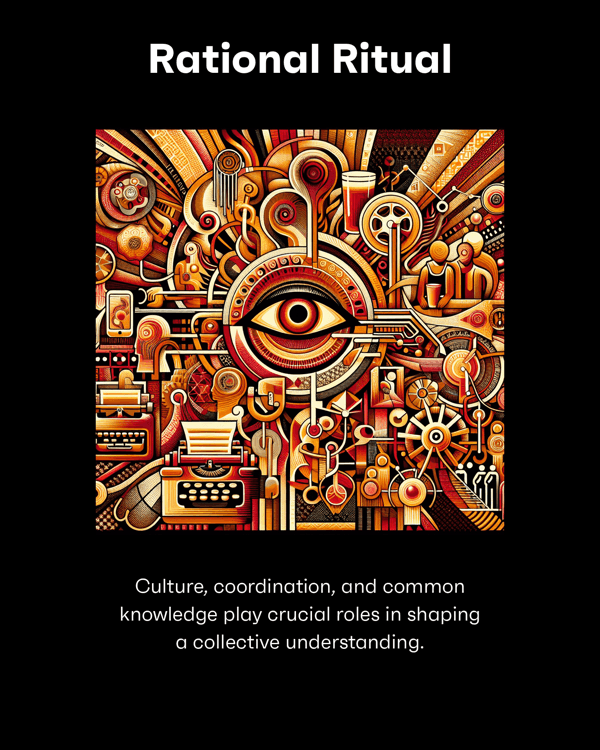
Decisions about what to buy often depend on social coordination, where the value of a product increases with its adoption by others. This principle extends beyond practical items like fax machines to social goods such as beer, clothing, and movies, with advertisements—especially during widely viewed events like the Super Bowl—playing a critical role in creating shared awareness. Similarly, coordination issues arise in collective actions, such as protests, where participation depends on the belief that others will also join, highlighting the importance of common knowledge. This concept, exemplified by the distinction between CC and BCC email fields, is central to understanding how societal norms and authority are maintained. Ceremonies and symbols, like royal progresses or revolutionary rituals, establish shared understanding, while practical changes, such as adopting new measurements or road rules, further reinforce collective alignment. Social networks also reveal the power of strong connections in fostering common knowledge, crucial for coordinated actions, compared to weak connections, which excel at spreading information. Even seemingly logical coordination problems, like choosing which side of the road to drive on, rely on culturally rooted shared knowledge. The panopticon prison design, with its centralized, divided, and asymmetrical visibility, serves as a metaphor for authority, illustrating how surveillance and ritualistic displays of power suppress common knowledge and maintain control.

clock11 min
bite6 Bite
target Einblick

Worum geht es?

This book delves into the intricate ways social coordination shapes human behavior, from purchasing decisions to collective actions. Exploring concepts like common knowledge, the dynamics of strong and weak social connections, and the cultural factors influencing logical choices, it reveals how shared understanding underpins societal and political structures. Through engaging examples—from Super Bowl ads to revolutionary ceremonies and even the panopticon prison—it examines the subtle mechanisms that drive cooperation, compliance, and collective action. A thought-provoking journey into the interplay of logic, emotion, and culture, this work unpacks the hidden forces that bind societies together.

Buchzusammenfassung

Michael Suk-Young Chwe is a professor of political science at University of California, Los Angeles, where he teaches game theory. He’s also the author of Jane Austen, Game Theorist.

Decisions about what to buy often depend on social coordination, where the value of a product increases with its adoption by others. This principle extends beyond practical items like fax machines to social goods such as beer, clothing, and movies, with advertisements—especially during widely viewed events like the Super Bowl—playing a critical role in creating shared awareness. Similarly, coordination issues arise in collective actions, such as protests, where participation depends on the belief that others will also join, highlighting the importance of common knowledge. This concept, exemplified by the distinction between CC and BCC email fields, is central to understanding how societal norms and authority are maintained. Ceremonies and symbols, like royal progresses or revolutionary rituals, establish shared understanding, while practical changes, such as adopting new measurements or road rules, further reinforce collective alignment. Social networks also reveal the power of strong connections in fostering common knowledge, crucial for coordinated actions, compared to weak connections, which excel at spreading information. Even seemingly logical coordination problems, like choosing which side of the road to drive on, rely on culturally rooted shared knowledge. The panopticon prison design, with its centralized, divided, and asymmetrical visibility, serves as a metaphor for authority, illustrating how surveillance and ritualistic displays of power suppress common knowledge and maintain control.

Um den Rest des Buches zu lesen, können Sie Bitely herunterladen

appstoregoogleplayapp gallery
Alle Bissen
bite6 Bites

The Power of Common Knowledge in Action

1
logo

Crafting Authority Through Shared Rituals

2
logo

How Social Validation Shapes What We Buy

3
logo

How Social Ties Shape Collective Action

4
logo

Authority Through Architecture: The Panopticon Effect

5
logo

How Shared Knowledge Shapes Collective Decisions

6
logo

Verwandte Bücher

mailbox-icon

Möchten Sie weiter lernen?

Verpassen Sie keine Updates aus dem aufregenden Universum von Bitely!