
Biography & History
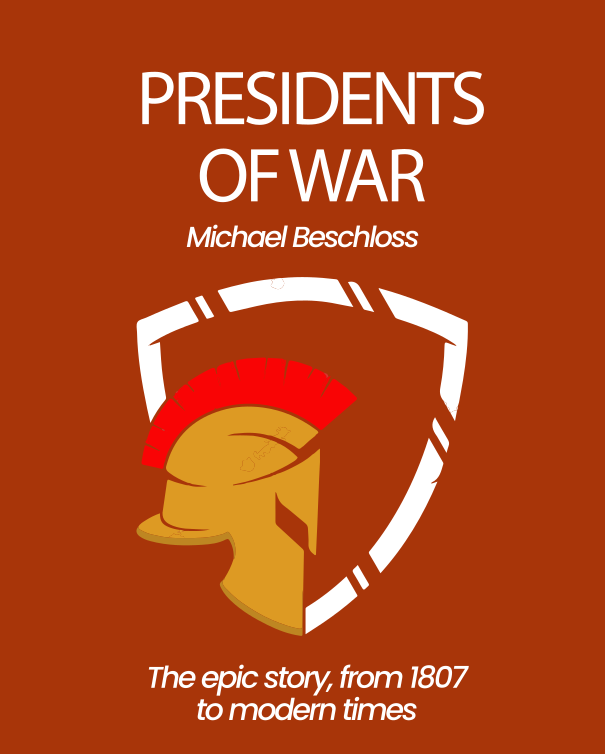
Presidents of WarPresidents of War
Presidents of War

Presidents of War

user-icon

Michael Beschloss

The history of America's wartime presidents is a diverse one, and when examined objectively, it becomes evident that even highly esteemed leaders during times of conflict made both positive and negative decisions. Presidential motivations for war have varied, with some aiming to unify or defend their nation, while others sought territorial expansion or solutions that could have been achieved through diplomacy. However, a common thread that runs through this overarching American narrative is the departure from the Founding Fathers' vision that only the Congress and Senate should hold the power to officially declare war.

hashtagpolitics
hashtagamerican-history
hashtagwar
clock29 min
bite10 Bite
target Einblick

Worum geht es?

Presidents of War, published in 2018, provides a detailed analysis of eight U.S. presidents and their roles in leading the nation into various conflicts. It explores each president's reasons for going to war, their actions during wartime, and the prevailing sentiments among the press and the public within the country. These compelling portraits of wartime leaders offer a sweeping view of American history, spanning from the War of 1812 to the Vietnam War.

Buchzusammenfassung

Michael Beschloss has published nine books on American presidents and edited Jacqueline Kennedy's book on President John F. Kennedy. He is also NBC News Presidential Historian and PBS NewsHour contributor, and has received six honorary degrees and an Emmy.

The history of America's wartime presidents is a diverse one, and when examined objectively, it becomes evident that even highly esteemed leaders during times of conflict made both positive and negative decisions. Presidential motivations for war have varied, with some aiming to unify or defend their nation, while others sought territorial expansion or solutions that could have been achieved through diplomacy. However, a common thread that runs through this overarching American narrative is the departure from the Founding Fathers' vision that only the Congress and Senate should hold the power to officially declare war.

“Not all readers become leaders, but all leaders must be readers.”

“Terror and blackmail are in the order of things in that country, Where money is law, power, and force.”

“The great problem? “We both look at the same set of facts and see different things.”

Um den Rest des Buches zu lesen, können Sie Bitely herunterladen
appstoregoogleplayapp gallery
Alle Bissen
bite10 Bites

Thomas Jefferson skillfully used his presidential authority to prevent the United States from entering a war.

1
logo

James Madison reluctantly succumbed to persuasion and engaged in the War of 1812.

2
logo

James Polk was resolute in pursuing a war for the purpose of expanding the nation's territory.

3
logo

In order to fight a war that he believed was morally just, Abraham Lincoln made some decisions that infringed upon civil libe­rties.

4
logo

Spanish-American War may have been caused by a misinterpretation.

5
logo

Woodrow Wilson deceived the public by implying that the United States would not be involved in World War I.

6
logo

Despite being a great leader during times of war, President Franklin D. Roosevelt made some regrettable choices.

7
logo

President Truman displayed a lack of assertiveness in dealing with North Korea.

8
logo

Lyndon Johnson employed deception to intensify the Vietnam War.

9
logo

Presidents have consistently disregarded the principles of the Founding Fathers and utilized their authority to initiate wars.

10
logo

Verwandte Bücher

mailbox-icon

Möchten Sie weiter lernen?

Verpassen Sie keine Updates aus dem aufregenden Universum von Bitely!