Self-Growth
PresencePresence
Presence

Presence

user-icon

Amy Cuddy

When teaching at Harvard Business School, Cuddy not only prompts student participation, but also emphasizes its impact on their final grades. Despite this motivation, some students still choose not to engage in class. Interestingly, Cuddy observed that changing these students' body language and posture also changed their willingness to participate. She realized that lack of participation was not due to comprehension issues, as they performed well on evaluations. Instead, non-participating students exhibited powerless body language, gravitating towards the edges of the room with heads down and limbs crossed tightly. This body language revealed and reinforced a sense of negative self-worth, hindering social and academic goals. A 2010 study by Cuddy and colleagues found that improving posture can enhance empowerment. Participants mimicked powerful and powerless poses, with those mimicking power poses more willing to take risks in a subsequent dice game. By adopting positive posture, known as power poses, individuals can strengthen their approach system and seize opportunities in life.

hashtagcommunication
clock10 min
bite7 Bite
target Einblick

Worum geht es?

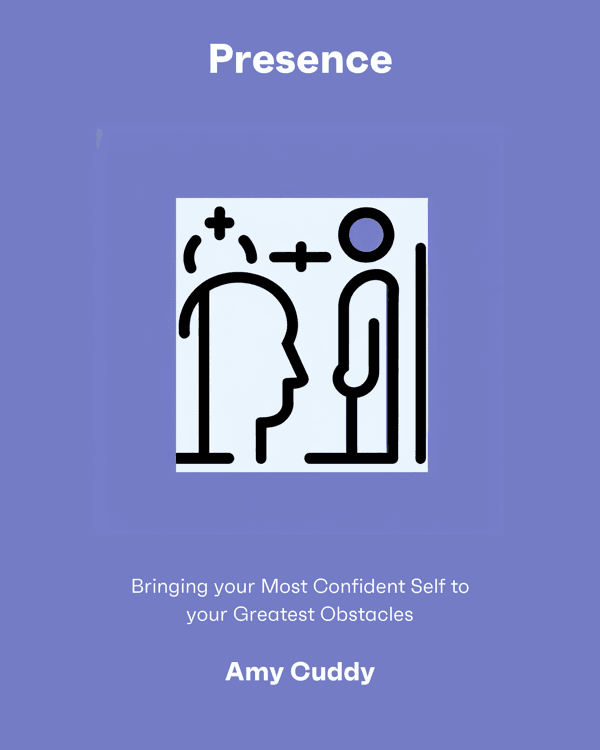
In her book Presence (2016), Amy Cuddy delves into the connection between our mind and body, and its impact on our mental state and communication skills. By analyzing nonverbal cues and physical stances, Cuddy uncovers practical techniques that have the power to empower introverted individuals and boost their self-confidence.

Buchzusammenfassung

Amy Cuddy is an author and psychologist who teaches at the Harvard Business School. In 2012, she became world renowned for her TED Talk on the benefits of power posing. Her first major book, Presence, is a New York Times and Washington Post bestseller that has been translated into thirty languages.

When teaching at Harvard Business School, Cuddy not only prompts student participation, but also emphasizes its impact on their final grades. Despite this motivation, some students still choose not to engage in class. Interestingly, Cuddy observed that changing these students' body language and posture also changed their willingness to participate. She realized that lack of participation was not due to comprehension issues, as they performed well on evaluations. Instead, non-participating students exhibited powerless body language, gravitating towards the edges of the room with heads down and limbs crossed tightly. This body language revealed and reinforced a sense of negative self-worth, hindering social and academic goals. A 2010 study by Cuddy and colleagues found that improving posture can enhance empowerment. Participants mimicked powerful and powerless poses, with those mimicking power poses more willing to take risks in a subsequent dice game. By adopting positive posture, known as power poses, individuals can strengthen their approach system and seize opportunities in life.

Um den Rest des Buches zu lesen, können Sie Bitely herunterladen
appstoregoogleplayapp gallery
Alle Bissen
bite7 Bites

The messages our bodies send are more significant than the words we speak, making nonverbal communication essential.

1
logo

Affirming your fundamental principles is simple, and it enhances your credibility and ability to withstand pressure.

2
logo

Feeling like a fraud is a widespread issue, so don't allow it to hold you back.

3
logo

Feeling helpless may result in true helplessness, yet there are solutions for it.

4
logo

The relationship between power and movement is closely intertwined.

5
logo

There are two primary operations of our nervous system, and it is simple to trigger the relaxation mode.

6
logo

Nonverbal communication plays a significant role in social interactions, and enhancing your stance can be quite impactful.

7
logo

Verwandte Bücher

mailbox-icon

Möchten Sie weiter lernen?

Verpassen Sie keine Updates aus dem aufregenden Universum von Bitely!