Buchzusammenfassung
Dan Jones is a historian, broadcaster, and award-winning journalist. His books include Magna Carta, The Plantagenets, and The Templars,and have sold more than a million copies worldwide. He has written and hosted dozens of TV shows including the Netflix/Channel 5 series Secrets of Great British Castles. His writing has been published in newspapers and magazines including the Evening Standard, Sunday Times, and Spectator.
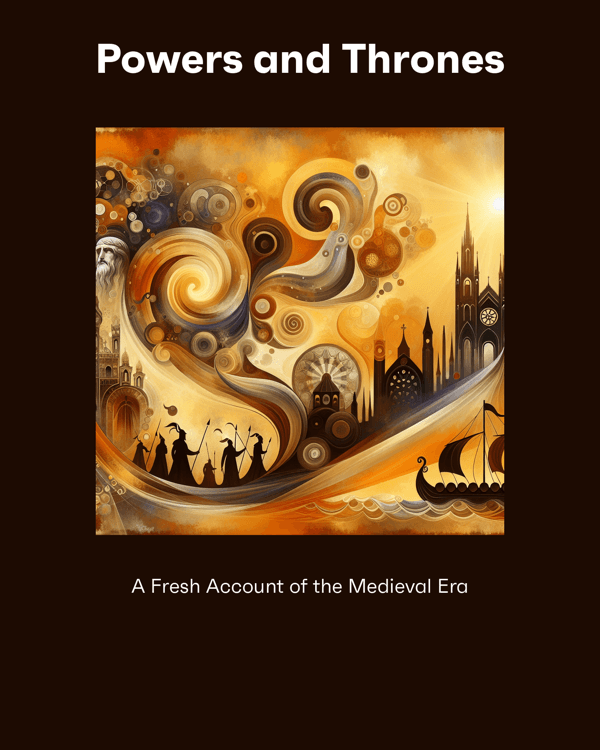
The Roman Empire, lasting over a millennium, deeply influenced the politics, culture, and religion of Africa, Asia Minor, and Europe, notably through the adoption of Christianity and the spread of Latin. However, environmental changes in the fourth century, including a severe drought in Asia, triggered the migration of the Huns, whose invasions displaced Gothic tribes into Roman territories. While initially managed by the Roman army, the influx of migrants and later campaigns by Attila the Hun in the fifth century destabilized the empire, culminating in the deposition of the last Roman emperor in 476. In the aftermath, barbarian kingdoms like the Franks rose to prominence, with the Merovingian dynasty expanding their influence across modern France and beyond. Under the Carolingian dynasty, Charlemagne revived a Christian empire in the west, but his successors failed to sustain his vision, leaving Europe vulnerable to Viking incursions. By the tenth century, the Vikings transitioned from raiders to settlers, with leaders like Rollo establishing Normandy. The fragmentation of the Carolingian Empire gave rise to Western Francia (France) and Eastern Francia (the Holy Roman Empire), shaping medieval Europe. Meanwhile, the Commercial Revolution of the Middle Ages transformed trade, with expanding networks, financial innovations, and a rising merchant class fostering economic growth and laying the foundations of modern capitalism. Cultural advancements also flourished, with scholars reviving ancient knowledge, builders creating enduring architectural marvels, and knights and monasteries becoming central to medieval life. The Byzantine Empire, evolving from the eastern Roman Empire, reached its height under Justinian I, who reformed Roman law, built the Hagia Sophia, and reclaimed lost territories, though his reign faced setbacks from environmental crises and the Plague of Justinian. Later, Emperor Heraclius solidified Byzantium’s identity by adopting Greek as its official language. The Crusades, initiated in the late eleventh century, reflected the influence of knights and clergy, with campaigns initially aimed at reclaiming Jerusalem but later targeting various foes. Concurrently, Islam emerged in the seventh century, profoundly shaping global history. By the fourteenth century, the Little Ice Age and overpopulation led to famine, followed by the Black Death, which devastated Europe, exposing societal inequalities and prompting shifts in class dynamics. The Renaissance, beginning in the late 1300s, ushered in a cultural revival inspired by ancient civilizations, with patrons like the Medici family fostering advancements in art and science. This era also marked the start of European exploration, epitomized by Columbus’s 1492 voyage to the Americas, which initiated a new era of global interaction.
Um den Rest des Buches zu lesen, können Sie
Bitely herunterladen








 15 min
 9 Bite
 Einblick
 9 Bites