Biography & History
PalestinePalestine
Palestine

Palestine

user-icon

Nur Masalha

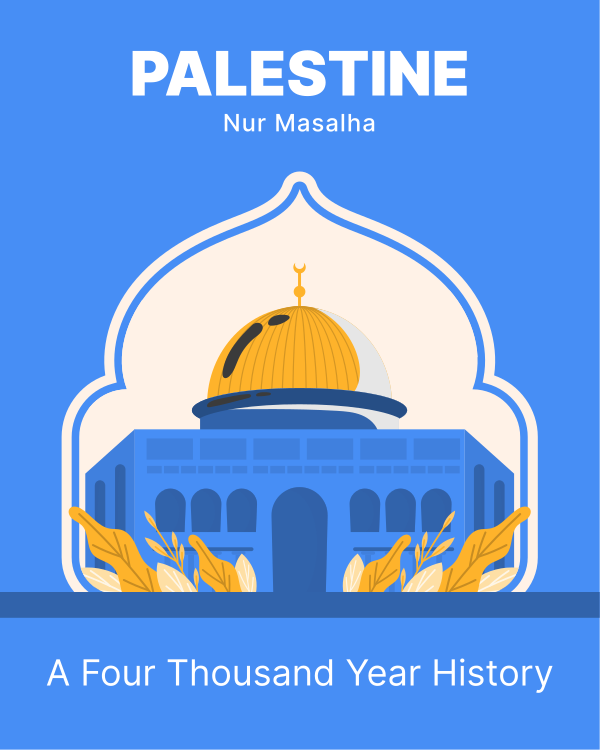
For 3,200 years, "Palestine" has been the prevalent term for the region between Egypt and Lebanon on the Mediterranean Sea. With its extensive history, Palestine has served as a diverse hub for numerous religions, languages, and ethnic groups. Present-day Palestinian Arabs have a blended heritage of Greek, Philistine, Israelite, Arab, Roman and other groups who have inhabited the area over time. Despite Islam being the dominant religion for the past 1,400 years, Christianity and Judaism have been consistently practiced by the indigenous people for thousands of years. However, the uninterrupted existence of the Palestinian people has been disrupted by Zionism, a European colonial endeavor that aims to establish Palestine as its own territory, resulting in the displacement of its cities and the appropriation of its culture and language.

hashtagworld-history
hashtagpolitics
hashtagreligion
hashtagmiddle-east
clock18 min
bite9 Bite
target Einblick

Worum geht es?

Palestine by Nur Masalha provides a detailed account of the historical trajectory of the land situated in the eastern Mediterranean, spanning from modern-day Lebanon to Egypt. Masalha skillfully weaves together a diverse range of sources, encompassing both ancient and modern perspectives, to construct a nuanced historical narrative. The exploration of the region extends from its ancient Philistine roots to the emergence of Palestinian nationalism in the nineteenth century, culminating in the establishment of Israel in 1948.

Buchzusammenfassung

Nur Masalha, a Palestinian historian, has authored multiple books on the subject of Palestine-Israel. Presently, her research is centered around the intersections of religion and politics in the Middle East, as well as topics such as oral history and social memory theory, subaltern studies, and emerging historiography in both Palestinian and Israeli contexts.

For 3,200 years, "Palestine" has been the prevalent term for the region between Egypt and Lebanon on the Mediterranean Sea. With its extensive history, Palestine has served as a diverse hub for numerous religions, languages, and ethnic groups. Present-day Palestinian Arabs have a blended heritage of Greek, Philistine, Israelite, Arab, Roman and other groups who have inhabited the area over time. Despite Islam being the dominant religion for the past 1,400 years, Christianity and Judaism have been consistently practiced by the indigenous people for thousands of years. However, the uninterrupted existence of the Palestinian people has been disrupted by Zionism, a European colonial endeavor that aims to establish Palestine as its own territory, resulting in the displacement of its cities and the appropriation of its culture and language.

Um den Rest des Buches zu lesen, können Sie Bitely herunterladen

appstoregoogleplayapp gallery
Alle Bissen
bite9 Bites

Palestine's historical roots date back to the Late Bronze Age, approximately 3,200 years ago.

1
logo

Ancient Palestine thrived during Greek and Roman rule.

2
logo

During the Byzantine era, Palestine experienced the ascent of Christianity and the rise of Arabs to influential positions.

3
logo

Following the Muslim conquest of Palestine in 637 AD, prosperity, Arabization, and Islamization increased.

4
logo

Following the expulsion of European Crusaders, Palestine came under the rule of the Ayyubid and Mamluk dynasties.

5
logo

In the 18th century, the rule of the Ottoman Empire in Palestine was replaced by an autonomous Palestinian state.

6
logo

Contemporary Palestinian nationalism came into existence in the early 1800s and grew stronger with the onset of Zionism.

7
logo

The Zionist endeavor originated from European settler colonialism and racial discrimination.

8
logo

The deliberate erasure of Palestinian history by Israel is pervasive and a well-known fact.

9
logo

Verwandte Bücher

mailbox-icon

Möchten Sie weiter lernen?

Verpassen Sie keine Updates aus dem aufregenden Universum von Bitely!