Biography & History
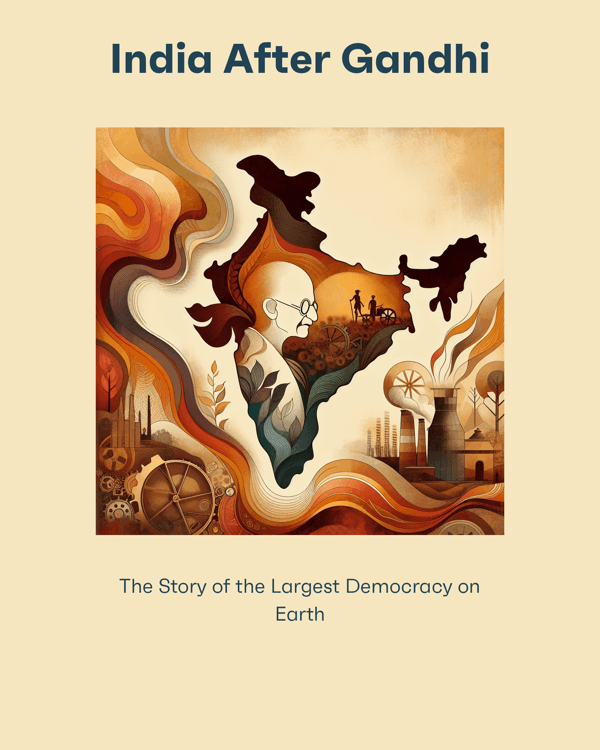
India After GandhiIndia After Gandhi

India After Gandhi

user-icon

Ramachandra Guha

The partition of India and the subsequent events shaped the subcontinent's complex history, marked by communal tensions, political miscalculations, and transformative leadership. Jammu and Kashmir, initially envisioned as a neutral state by its ruler, became a flashpoint due to invasions by pro-Pakistan forces, leading to Indian military intervention and the establishment of the Line of Control. Despite British skepticism about India's democratic viability, the 1952 general election defied expectations, with Nehru's INC securing a majority amidst challenges like illiteracy and poverty. Nehru's leadership focused on nation-building through agricultural and industrial reforms, constitutional protections for marginalized groups, and fostering international relations, particularly with the USSR. However, partition's aftermath brought immense refugee crises and communal violence, which Gandhi sought to quell through non-violence until his assassination in 1948. Post-Nehru, Indira Gandhi's tenure saw bold economic moves like bank nationalization and agricultural advancements but was marred by crises like the Emergency, Operation Bluestar, and her assassination. Her son Rajiv Gandhi's leadership introduced economic liberalization but faced challenges from rising Hindu nationalism and rural discontent. The INC's dominance waned as coalition politics emerged, while economic reforms and globalization transformed India's economy, lifting millions out of poverty but leaving rural inequalities unresolved. Amidst political turbulence, India navigated its identity as a secular democracy, balancing progress with persistent social and religious tensions.

clock31 min
bite16 Bite
target Einblick

Worum geht es?

The book delves into the complex history of modern India, tracing its journey from British colonial rule to its emergence as a vibrant democracy. It explores pivotal events like the partition, the Kashmir conflict, and the rise of religious nationalism, while examining the social, political, and economic transformations that shaped the nation. Through the lens of key figures and movements, the narrative captures India's struggles and triumphs, offering a nuanced understanding of its evolution into a modern state. Rich in detail and insight, it highlights the resilience and diversity that define India's identity.

Buchzusammenfassung

Ramachandra Guha is an Indian historian and writer. His works have been translated into twenty languages, and have won a number of prizes. As well as being a regular contributor to the Telegraph and Hindustan Times, he is the author of numerous titles, such as Gandhi Before India and Gandhi: The Years That Changed the World, 1914–1948.

The partition of India and the subsequent events shaped the subcontinent's complex history, marked by communal tensions, political miscalculations, and transformative leadership. Jammu and Kashmir, initially envisioned as a neutral state by its ruler, became a flashpoint due to invasions by pro-Pakistan forces, leading to Indian military intervention and the establishment of the Line of Control. Despite British skepticism about India's democratic viability, the 1952 general election defied expectations, with Nehru's INC securing a majority amidst challenges like illiteracy and poverty. Nehru's leadership focused on nation-building through agricultural and industrial reforms, constitutional protections for marginalized groups, and fostering international relations, particularly with the USSR. However, partition's aftermath brought immense refugee crises and communal violence, which Gandhi sought to quell through non-violence until his assassination in 1948. Post-Nehru, Indira Gandhi's tenure saw bold economic moves like bank nationalization and agricultural advancements but was marred by crises like the Emergency, Operation Bluestar, and her assassination. Her son Rajiv Gandhi's leadership introduced economic liberalization but faced challenges from rising Hindu nationalism and rural discontent. The INC's dominance waned as coalition politics emerged, while economic reforms and globalization transformed India's economy, lifting millions out of poverty but leaving rural inequalities unresolved. Amidst political turbulence, India navigated its identity as a secular democracy, balancing progress with persistent social and religious tensions.

Um den Rest des Buches zu lesen, können Sie Bitely herunterladen
appstoregoogleplayapp gallery
Alle Bissen
bite16 Bites

Forging Unity: India’s Journey to Independence

1
logo

India's Struggle: Unity Amidst Partition's Turmoil

2
logo

Divided Subcontinent: The Forces Behind Partition

3
logo

Partition's Fallout: The Battle for Kashmir

4
logo

Reshaping a Nation: Refugees, Revolution, and Resilience

5
logo

India’s Democratic Triumph: Defying Colonial Doubts

6
logo

Building a Modern India: Nehru’s Transformative Vision

7
logo

Nehru's Struggles: Kerala Reforms and China Conflict

8
logo

Indira Gandhi's Rise Amidst Crisis

9
logo

India's Turning Point: War, Protests, and Political Upheaval

10
logo

Indira Gandhi's Emergency: Power and Controversy

11
logo

Indira Gandhi’s Fall, Resurgence, and Legacy

12
logo

Indira Gandhi’s Legacy: Turmoil, Tragedy, and Transformation

13
logo

Economic Shifts and Rising Tensions in 1980s India

14
logo

Hindu Nationalism and India's Political Transformation

15
logo

Bridging Divides: India's Path to Progress

16
logo

Verwandte Bücher

mailbox-icon

Möchten Sie weiter lernen?

Verpassen Sie keine Updates aus dem aufregenden Universum von Bitely!