Buchzusammenfassung
James Gleick is an American author, journalist, and historian of science known for his engaging and accessible writing on complex scientific and technological topics. He has written extensively about the history and impact of various scientific disciplines, particularly in the realm of chaos theory and information theory.
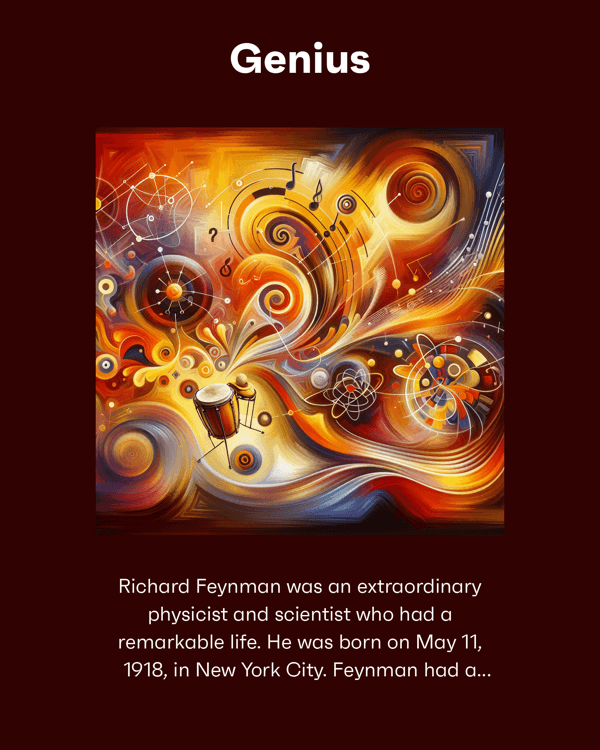
Richard Feynman’s journey was marked by a unique blend of intellectual brilliance, unconventional methods, and a vivid imagination that set him apart in both his personal and professional life. From excelling in high-pressure math competitions through visualization techniques to revolutionizing quantum physics with his Feynman diagrams, his ability to think independently and creatively was a constant theme. Shaped by his father’s emphasis on understanding over memorization, Feynman carried this philosophy into his advocacy for clearer scientific education and his transformative teaching style, which inspired generations of physicists. His contributions to the Manhattan Project demonstrated his capacity to bridge theoretical insights with practical applications, while his eccentric passions, such as playing the bongos and storytelling, revealed a playful side to his character. Though his unorthodox approach sometimes drew criticism, it was integral to his groundbreaking achievements, leaving a legacy of innovation and originality that continues to influence science today.
"When information is cheap, attention becomes expensive."
"It is not the amount of knowledge that makes a brain. It is not even the distribution of knowledge. It is the interconnectedness."
"Maybe that’s why young people make success. They don’t know enough. Because when you know enough it’s obvious that every idea that you have is no good."
Um den Rest des Buches zu lesen, können Sie
Bitely herunterladen









 11 min
 7 Bite
 Einblick
 7 Bites