Buchzusammenfassung
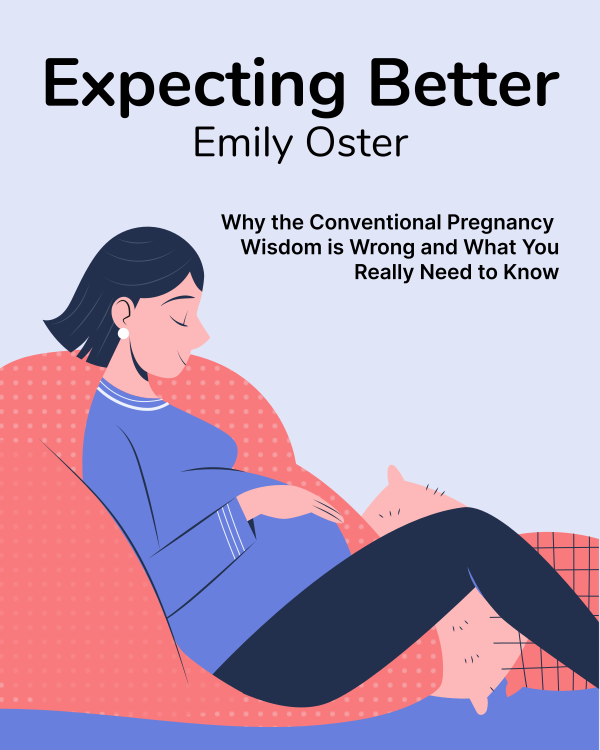
Emily Oster is an economist and author. Her research focuses on statistical techniques and health economics.Her research focuses on health economics and statistical methods. She is currently a professor at Brown University.
It is essential to gather accurate information when evaluating the risks and benefits of various choices related to pregnancy. Some perceived risks may not be as severe as they seem, while certain commonly accepted practices may not be entirely safe. Remember, aren't custom fit for every person or situation, and not all scientific studies are of the highest standard. So, keep questioning - stay curious.
Conduct your research wisely.
When examining the pros and cons of a decision based on research studies, it is crucial to consider the distinction between correlation and causation. For instance, if a child who watches a significant amount of television performs poorly on tests, this indicates a correlation. However, it does not prove that television is directly responsible for the decline in intelligence, as other factors like parental influence and the home environment should be taken into account. Understanding these differences plays a vital role in assessing the validity of scientific experiments.
"Before the baby, you’re a vessel to be cherished and protected. After the baby, you’re a lactation-oriented baby accessory."
"Being pregnant was a lot like being a child again. There was always someone telling you what to do."
"Parenting is much more about the child than about the parent."
Um den Rest des Buches zu lesen, können Sie
Bitely herunterladen









 23 min
 8 Bite
 Einblick
 8 Bites