
Health, Sports, Lifestyle
EndureEndure
Endure

Endure

user-icon

Alex Hutchinson

In these bites, we learn that endurance is not just about muscle power, but also involves many physiological elements and psychological factors. These factors play a significant role in athletic performance and setting world records in endurance sports. If a method, even if it's just a placebo, helps with recovery, athletes should use it. Taking an ice bath after competition is believed to aid recovery, even though studies show no direct benefit. Belief can be just as important as science.

hashtagsports
hashtaghealth
clock17 min
bite8 Bite
target Einblick

Worum geht es?

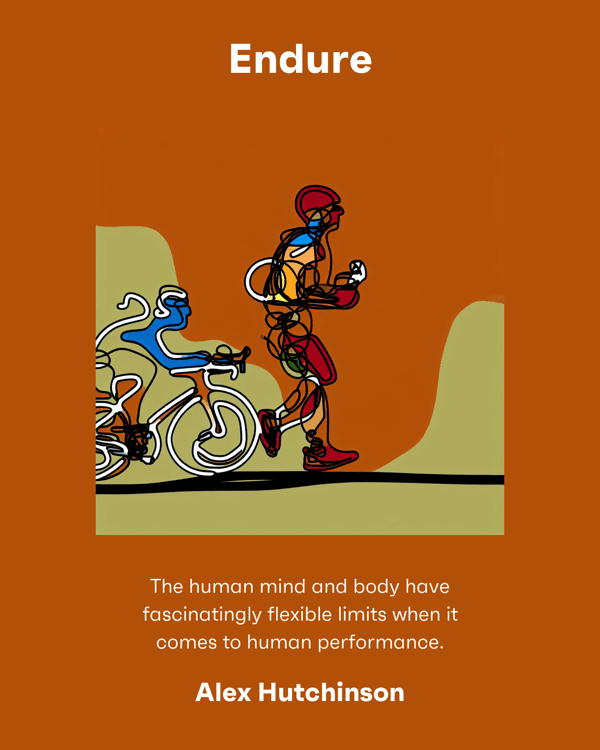
In Endure (2018), Alex Hutchinson delves into the reasons why some athletes who constantly push their limits can endure immense pain and effort and continue onwards. Hutchinson investigates the intricate and diverse elements that contribute to the ability of marathon runners and cyclists to shatter records and achieve unprecedented levels of endurance.

Buchzusammenfassung

Alex Hutchinson is an award-winning journalist and contributing editor to Outside magazine. His work has also been featured in the New Yorker, the New York Times, the Globe and Mail and Runner’s World. With a PhD in physics from the University of Cambridge, as well as a true passion for the outdoors and running, he is uniquely qualified to research the science behind fitness and endurance.

In these bites, we learn that endurance is not just about muscle power, but also involves many physiological elements and psychological factors. These factors play a significant role in athletic performance and setting world records in endurance sports. If a method, even if it's just a placebo, helps with recovery, athletes should use it. Taking an ice bath after competition is believed to aid recovery, even though studies show no direct benefit. Belief can be just as important as science.

Um den Rest des Buches zu lesen, können Sie Bitely herunterladen
appstoregoogleplayapp gallery
Alle Bissen
bite8 Bites

Attempting to push the boundaries of human resilience can result in lethal outcomes. Striving to challenge the thresholds of human fortitude can lead to deadly repercussions. Endeavoring to explore the bounds of human perseverance can result in fatal outcomes.

1
logo

We naturally regulate our speed when approaching the last effort in endurance running.

2
logo

Feeling fatigued can impact your ability to endure physical activities.

3
logo

Athletes possess an elevated capacity to endure pain, exceeding that of ordinary individuals, thereby enhancing their performance.

4
logo

Athletic performance heavily relies on the intake of oxygen.

5
logo

Endurance is also affected by the core temperature of the body.

6
logo

Practicing mindfulness reduces stress and enhances athletic abilities.

7
logo

The insular and motor cortices are the brain regions primarily associated with endurance. The regions of the brain that are most connected to endurance are the insular and motor cortices. Endurance is mainly linked to the insular and motor cortices of the brain. When it comes to endurance, the insular and motor cortices of the brain play a crucial role. The insular and motor cortices of the brain are particularly significant in relation to endurance.

8
logo

Verwandte Bücher

mailbox-icon

Möchten Sie weiter lernen?

Verpassen Sie keine Updates aus dem aufregenden Universum von Bitely!