Biography & History
Bedtime Biography: EdisonBedtime Biography: Edison

Bedtime Biography: Edison

user-icon

Edmund Morris

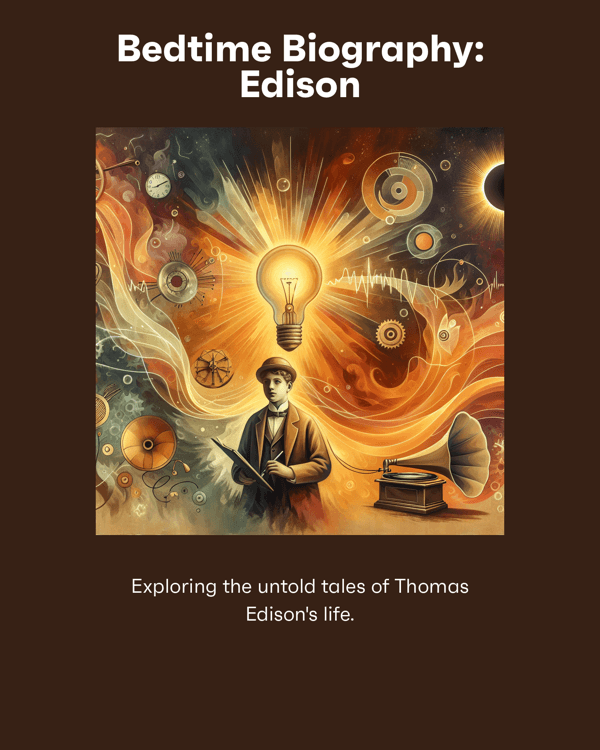
At fifteen, Alva Edison became a traveling telegraph operator, excelling due to his self-taught Morse code skills and filling notebooks with ideas to improve telegraph circuits. Hired by Western Union, he soon transitioned to inventing, starting with an electric vote recorder that failed commercially, prompting him to focus on marketable innovations. After enhancing the stock ticker and moving to New York, Edison gained recognition and established a research lab in Menlo Park, where he invented the phonograph, revolutionizing sound recording. His relentless experimentation led to breakthroughs like the carbon microphone and, inspired by a solar eclipse, the electric light system, overcoming early failures to create a practical, long-lasting lightbulb. Despite professional triumphs, Edison faced personal losses, including the death of his first wife, Mary, before remarrying Mina Miller, whose support fueled another surge of creativity. By the time of his death in 1931, Edison had transformed the modern world, leaving an indelible legacy of innovation.

clock8 min
bite4 Bite
target Einblick

Worum geht es?

Thomas Alva Edison’s life is a testament to relentless curiosity and groundbreaking innovation. From his humble beginnings as a self-taught telegraph operator to becoming one of history’s most prolific inventors, Edison’s journey is marked by perseverance, creativity, and an unyielding drive to improve the world. His transformative inventions, including the phonograph and the electric light system, revolutionized daily life and cemented his legacy as a visionary. This story captures the triumphs, challenges, and personal sacrifices behind the man who forever changed the course of history.

Buchzusammenfassung

Edmund Morris (1940-2019) was a prolific writer and author. In 1980, he won the Pulitzer Prize for his first book, The Rise of Theodore Roosevelt. He famously authored Dutch, a crucially acclaimed but controversial biography of Ronald Reagan. The last biography he wrote was Edison, published in the year of his death.

At fifteen, Alva Edison became a traveling telegraph operator, excelling due to his self-taught Morse code skills and filling notebooks with ideas to improve telegraph circuits. Hired by Western Union, he soon transitioned to inventing, starting with an electric vote recorder that failed commercially, prompting him to focus on marketable innovations. After enhancing the stock ticker and moving to New York, Edison gained recognition and established a research lab in Menlo Park, where he invented the phonograph, revolutionizing sound recording. His relentless experimentation led to breakthroughs like the carbon microphone and, inspired by a solar eclipse, the electric light system, overcoming early failures to create a practical, long-lasting lightbulb. Despite professional triumphs, Edison faced personal losses, including the death of his first wife, Mary, before remarrying Mina Miller, whose support fueled another surge of creativity. By the time of his death in 1931, Edison had transformed the modern world, leaving an indelible legacy of innovation.

Um den Rest des Buches zu lesen, können Sie Bitely herunterladen
appstoregoogleplayapp gallery
Alle Bissen
bite4 Bites

Inventing Focus: The Early Life of Edison

1
logo

Young Edison Takes the Helm

2
logo

Thomas Edison: The Relentless Pursuit of Innovation

3
logo

Illuminating the World: Edison's Relentless Genius

4
logo

Verwandte Bücher

mailbox-icon

Möchten Sie weiter lernen?

Verpassen Sie keine Updates aus dem aufregenden Universum von Bitely!