Politics & Society
Imagined CommunitiesImagined Communities
Imagined Communities

Imagined Communities

user-icon

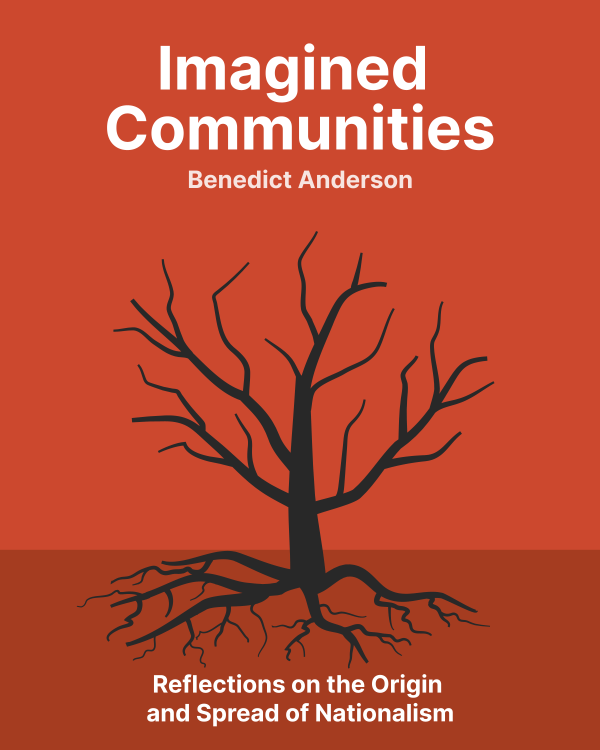
Benedict Anderson

As envisioned by nationalism, nations are communities of people who share common interests and traits and, most importantly, a common language. Although it isn't a political ideology, it is a system of cultural beliefs that provides a sense of continuity in a fluctuating world. At first, nationalism was a side effect of "print capitalism." To expand their market, booksellers gave up sacred languages like Latin and used vernaculars such as German. In this way, groups of readers could imagine themselves as communities sharing specific interests. As local languages became standardized and newspapers emerged, national interests in Europe and worldwide were consolidated, eventually destroying multinational empires.

hashtagtrending
hashtagsociology
hashtagpolitical-science
hashtagnationalism
clock17 دقيقة
bite7 Bite
target رؤية

ما الموضوع؟

In terms of the origins of nationalism, Imagined Communities is regarded as one of the most influential studies in this field. Throughout the book, Anderson attempts to answer a question that has long baffled his fellow historians: Why are nations a defining identity in the world we live in today? Our visit to Anderson's interesting explanation of this mystery will include a look at the history of capitalism, religious belief systems, the printing press, and nationalism.

ملخص الكتاب

Benedict Anderson (1936-2015) was a highly influential American political scientist, historian, and author known for his groundbreaking work in the fields of nationalism and Southeast Asian studies. His work on the concept of "imagined communities" has had a significant impact on the study of nationalism and identity.

As envisioned by nationalism, nations are communities of people who share common interests and traits and, most importantly, a common language. Although it isn't a political ideology, it is a system of cultural beliefs that provides a sense of continuity in a fluctuating world. At first, nationalism was a side effect of "print capitalism." To expand their market, booksellers gave up sacred languages like Latin and used vernaculars such as German. In this way, groups of readers could imagine themselves as communities sharing specific interests. As local languages became standardized and newspapers emerged, national interests in Europe and worldwide were consolidated, eventually destroying multinational empires.

“It is important to keep in mind that to learn a language is not simply to learn a linguistic means of communication. It is also to learn the way of thinking and feeling of a people who speak and write a language which is different from ours. It is to learn the history and culture underlying their thoughts and emotions and so to learn to empathize with them.”

“No one can be a true nationalist who is incapable of feeling ashamed if his or her state or government commits crimes including those against their fellow citizens.”

“The ideal way to start interesting research, at least in my view, is to depart from a problem or question to which you do not know the answer.”

لتقرأ بقية الكتاب يمكنك تنزيل Bitely

appstoregoogleplayapp gallery
كل اللقطات
bite7 Bites

Despite not being a religion, nationalism is more like a religious belief system than modern political philosophy.

1
logo

The vast empires and religious communities were held together by sacred languages.

2
logo

Through print capitalism, distinctive national languages were strengthened, and the basis of nationalism was established.

3
logo

Local newspapers solidified the idea of people as a collective with common interests.

4
logo

19th-century European nationalism was fueled by a linguistic revolution.

5
logo

Since nationalism was inconsistent with imperial rule, its emergence threatened Europe's multinational empires.

6
logo

The intellectuals of Africa and Asia used European ideas and colonial experiences to build their independent nations.

7
logo

كتب ذات صلة

mailbox-icon

هل تريد الاستمرار في التعلم؟

لا تفوت التحديثات من عالم Bitely المثير!

Logo
appstoregoogleplay
app gallery

تابعنا على وسائل التواصل الاجتماعي

tiktokxinstagramyoutubelinkedinfacebook