Business & Career
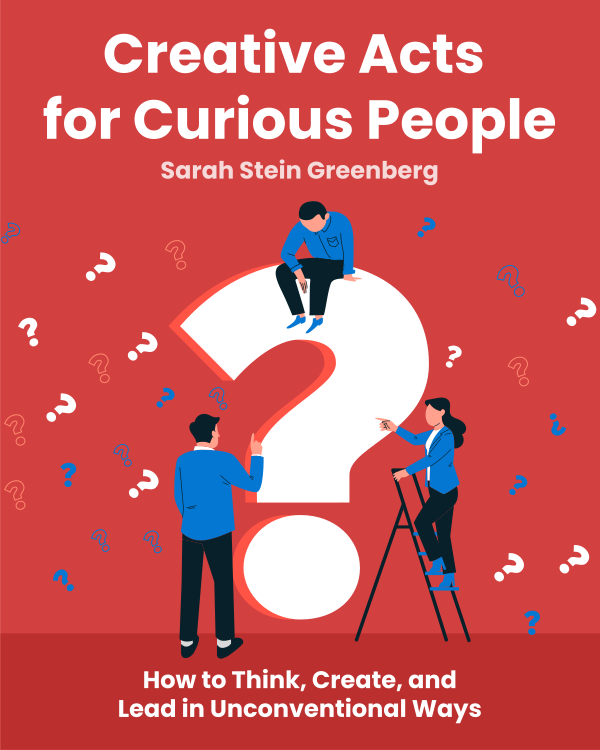
Creative Acts for Curious PeopleCreative Acts for Curious People
Creative Acts for Curious People

Creative Acts for Curious People

user-icon

Sarah Stein Greenberg

Taking action creatively and solving problems is the essence of design. It takes four key factors to improve your design skills: thinking, learning, acting, and feeling. In your personal life and the world around you, you can solve complicated challenges by being curious and open-minded. Find out what conditions are best for learning. “Learn How You Learn” is another technique utilized by the d.school. Take a moment to consider the experiences in your life that helped you gain a new understanding of a subject. This might have happened at school, in a personal or professional environment. List five features describing each moment: who you were with, what you were doing, and what was going on. Take a look at these attributes. Once you've determined how you learn best, think about recreating those conditions.

hashtagdesign
hashtagproblem-solving
hashtagcreativity
clock17 دقيقة
bite8 Bite
target رؤية

ما الموضوع؟

Creative Acts for Curious People (2021) presents ideas on design and creativity from the lessons of Stanford's prestigious Hasso Plattner School of Design, which is also called the d.school. Along with essays on the skills and mentality essential for creative action, it includes over 80 functional exercises utilized by professionals from many fields, such as education, nonprofits, and medicine. These exercises are designed to help you resolve issues, whether they are personal or global.

ملخص الكتاب

Sarah Stein Greenberg is an educator, author, and academic known for her work in the field of design thinking and design education. ​​She has been involved in teaching, research, and leadership related to design thinking and innovation at Stanford University and the Stanford d.school (Hasso Plattner Institute of Design at Stanford).

Taking action creatively and solving problems is the essence of design. It takes four key factors to improve your design skills: thinking, learning, acting, and feeling. In your personal life and the world around you, you can solve complicated challenges by being curious and open-minded. Find out what conditions are best for learning. “Learn How You Learn” is another technique utilized by the d.school. Take a moment to consider the experiences in your life that helped you gain a new understanding of a subject. This might have happened at school, in a personal or professional environment. List five features describing each moment: who you were with, what you were doing, and what was going on. Take a look at these attributes. Once you've determined how you learn best, think about recreating those conditions.

"Although breakthroughs feel great, struggle is how you get there."

"You have to develop your own creative process, your own vocabulary and your way of thinking about how creativity works for you."

لتقرأ بقية الكتاب يمكنك تنزيل Bitely

appstoregoogleplayapp gallery
كل اللقطات
bite8 Bites

In design, perception, observation, action, and reflection are all combined to solve problems.

1
logo

Try not to get too hung up trying to solve the problem.

2
logo

Develop patience to enhance your observation abilities.

3
logo

In data analysis, widen the focus of your research.

4
logo

Analyze the context of your project to comprehend its overall impact.

5
logo

Take part in active experimentation to discover how you work.

6
logo

Use warm-up exercises to foster trust and relationships among your team members.

7
logo

The creative epiphany usually occurs right after a period of productive struggle.

8
logo

كتب ذات صلة

mailbox-icon

هل تريد الاستمرار في التعلم؟

لا تفوت التحديثات من عالم Bitely المثير!

Logo
appstoregoogleplay
app gallery

تابعنا على وسائل التواصل الاجتماعي

tiktokxinstagramyoutubelinkedinfacebook